The 2026 Power List: Top 50 People Counting Solution Providers Ranked (Best Accuracy, Price & Features)
Top Picks at a Glance — 2026 People Counting Providers
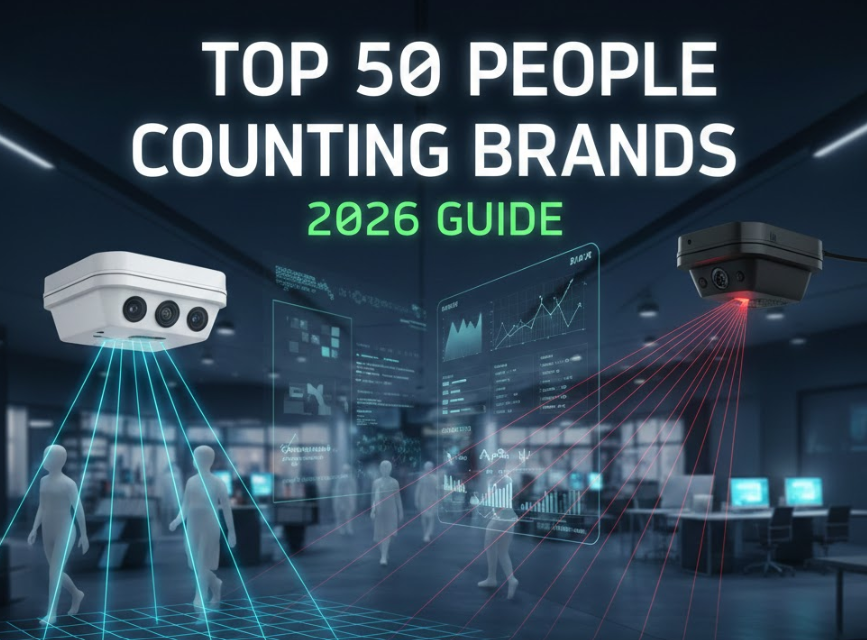
Quick answer: The 2026 Power List ranks the world’s best people counting solution providers by accuracy, AI capability, price, and features. #1 RetailNext (Aurora Series), #2 Xovis (PF-Series), and #3 FootfallCam (AI 3DPro2) lead the market, followed by Density, Vemco Group (Vemcount), SensMax, Axis Communications, Hikvision, Dor, and SenSource in the top 10.
Categories covered: AI vision, 3D stereo, LiDAR, thermal imaging, radar, and infrared beam sensors — for retail, airports, smart offices, transit, and public spaces.
Top 10 at a glance
- RetailNext (Aurora Series) — AI 3D vision, enterprise retail
- Xovis (PF-Series) — 3D stereo, airports & retail
- FootfallCam (AI 3DPro2) — AI 3D, affordable enterprise
- Density — LiDAR occupancy for smart offices
- Vemco Group (Vemcount) — universal software platform, hardware-agnostic
- SensMax (TAC-B Radar) — radar, outdoor & privacy-first
- Axis Communications (P8815-2) — IP camera analytics
- Hikvision (iDS-Series) — cost-efficient AI cameras
- Dor (Thermal Beam) — entry-level SMB retail
- SenSource — 3D stereo video, university & public buildings
Source: PeopleCountings 2026 Power List · Coverage: 50 providers across 6 sensor technologies and 5 industry verticals.
Why This List Matters in 2026
Choosing the wrong people counting system costs businesses thousands in lost revenue and bad decisions. In 2026, we analyzed 50 of the world’s top providers — comparing accuracy, pricing, AI capabilities, and real-world use cases — so you don’t have to. Whether you run a retail chain, an airport, or a smart office, this definitive guide reveals which solution is truly worth your investment.
1. RetailNext (Aurora Series)
- Technology: Deep Learning Optical Sensors.
- Description: An enterprise ecosystem that tracks the “Full-Path” shopper journey from the sidewalk to the checkout.
- Web Link: retailnext.net
- Pros: Comprehensive “Store Optimization” engine; integrates with POS and staff scheduling.
- Cons: Enterprise focus; complex for smaller single-store operations.
- Average Price: Custom enterprise quotes (Typically $1,500+ per zone).
2. Xovis (PF-Series)
- Technology: AI-Native 3D Stereovision.
- Description: Swiss engineering at its best. Their new PF-Series offers 8x more coverage than previous models, making it the top choice for massive spaces like airports.
- Web Link: xovis.com
- Pros: Incredible coverage per sensor; handles high-density “crush” crowds; 100% GDPR compliant.
- Cons: Hardware is aesthetically industrial; primarily handles the data (often needs a secondary dashboard partner).
- Average Price: $1,500 – $2,500 per unit.
3. FootfallCam (AI 3DPro2)
- Technology: Dual-Lens 3D AI.
- Description: Known for the best “Price-to-Performance” ratio. It’s the go-to for retail chains and public libraries.
- Web Link: footfallcam.com
- Pros: Competitive pricing; global installation network; 25+ built-in business reports.
- Cons: Cloud reporting can be slower with large datasets; basic sensor aesthetics.
- Average Price: $450 – $750 per sensor.
4. Density (LiDAR Technology)
- Technology: Laser LiDAR (Light Detection and Ranging).
- Description: The gold standard for privacy. It “sees” the room in 3D laser points without ever capturing a human face.
- Web Link: density.io
- Pros: Maximum privacy; works in 100% darkness; 3D scan of space included.
- Cons: Most expensive technology per square foot.
- Average Price: $2,000 – $3,500 per entry point.
5. Vemco Group (Vemcount)
- Technology: Universal Software Platform (Hardware Agnostic).
- Description: A Danish software powerhouse. In 2026, their “Vemcount” platform is the industry standard for combining data from different hardware brands into one dashboard.
- Web Link: vemcogroup.com
- Pros: Connect any sensor (Xovis, Axis, etc.); excellent mall management features.
- Cons: Significant annual software licensing fees.
- Average Price: €40 – €60 per month per sensor (SaaS).
6. SensMax (TAC-B Radar)
- Technology: mmWave Radar (77GHz).
- Description: The premier solution for Outdoor People Counting. It detects movement through fog, rain, and darkness.
- Web Link: sensmax.eu
- Pros: Works in all weather; no privacy issues (no cameras); can count cyclists and vehicles.
- Cons: Cannot distinguish demographics (age/gender).
- Average Price: $800 – $1,200 (Radar units).
7. Axis Communications (P8815-2)
- Technology: IP Camera-based Edge Counting.
- Description: Uses high-end security cameras as sensors. The “Edge AI” processes counts directly on the camera.
- Web Link: axis.com
- Pros: Dual-use (security + counting); 5-year warranty; open API.
- Cons: Software licenses are often sold separately.
- Average Price: $900 (Camera) + $250 (License).
8. Hikvision (iDS-Series)
- Technology: AI Triple-Lens Activity Analysis.
- Description: The budget-friendly heavyweight. Provides high-precision counting via Deep Learning models.
- Web Link: hikvision.com
- Pros: Lowest hardware entry price; massive global availability.
- Cons: Faces regulatory restrictions in some Western government sectors.
- Average Price: $350 – $550 per unit.
9. Dor (Thermal Beam)
- Technology: Battery-Powered Thermal Sensing.
- Description: A “plug-and-play” sensor that connects via 5G cellular. Ideal for pop-ups and boutiques.
- Web Link: getdor.com
- Pros: 10-minute DIY setup; no Wi-Fi or wiring required.
- Cons: Accuracy drops in very wide or high-ceiling entrances.
- Average Price: $350 upfront + $150/month subscription.
10. SenSource
- Technology: 3D Stereo Video.
- Description: A US-based stalwart with specialized dashboards for universities and public buildings.
- Web Link: sensourceinc.com
- Pros: Best-in-class US customer support; reliable 98%+ accuracy guarantee.
- Cons: Hardware is bulkier than modern European competitors.
- Average Price: $700 – $950 per unit.
11. V-Count (Ultima AI Series)
- Technology: 3D Stereo Vision with Edge AI.
- Description: The global leader in retail analytics. Their sensors use high-speed onboard processors to count people without sending images to the cloud.
- Web Link: v-count.com
- Pros: 99.9% accuracy; robust staff exclusion; identifies age, gender, and dwell zones.
- Cons: Higher hardware cost; requires stable ceiling mounting.
- Average Price: $800 – $900 per sensor + monthly SaaS fee.
12. Ariadne Maps (Germany / EU)
- Technology: Hybrid Fusion (Signal Sensing + ToF).
- Best For: Large malls and airports needing “Journey Analytics.”
- Pros: Tracks full customer paths without cameras; No personal data is captured at the sensor.
- Cons: Requires high-density sensor placement for path precision.
13. Traf-Sys
- Technology: 3D Stereo Video & Wireless Horizontal Beams.
- Description: A US-based veteran providing specialized solutions for retail and libraries. They are best known for their robust “VisiCount” software.
- Web Link: trafsys.com
- Pros: Highly reliable US-based support; flexible hardware options for various budgets.
- Cons: Horizontal beam systems (low-cost) struggle with side-by-side entries.
- Average Price: $450 (Beams) – $950 (3D sensors).
14. Milesight
- Technology: AI Time-of-Flight (ToF) & LoRaWAN.
- Description: A rising star in the IoT space. Their 2026 sensors are famous for using LoRaWAN, allowing for wireless data transmission over several kilometers.
- Web Link: milesight.com
- Pros: 99.8% accuracy; tiny, discreet hardware; low power consumption.
- Cons: ToF technology can be sensitive to direct sunlight near glass doors.
- Average Price: $550 – $800.
15. SMS Storetraffic
- Technology: 3D Video & “T.M.A.S.” Cloud Analytics.
- Description: A Canadian firm that focuses on the “Retail Equation”—converting traffic data into actual labor hours and profit insights.
- Web Link: storetraffic.com
- Pros: User-friendly “T.M.A.S.” app; great for multi-door comparison.
- Cons: Subscription-heavy model; hardware setup can be technical for DIYers.
- Average Price: $500 – $850 per unit.
16. Eco-Counter
- Technology: Passive Infrared (PIR) & Magnetometers.
- Description: The world leader in Outdoor & Trail Counting. They specialize in counting hikers, cyclists, and scooter users in nature parks.
- Web Link: eco-counter.com
- Pros: Solar-powered; ultra-rugged for extreme weather; invisible installation.
- Cons: Does not provide demographic data (age/gender).
- Average Price: $2,500 – $4,500 for a complete trail station.
17. Iris-GmbH
- Technology: Time-of-Flight (ToF) 3D.
- Description: High-frequency sensors designed for high-density environments like subway stations and massive venues.
- Web Link: irisys.net
- Pros: Extremely durable; handles 10+ people passing simultaneously with ease.
- Cons: Expensive; requires specialized integration.
- Average Price: $1,500+ per sensor.
18. FLIR Systems
- Technology: Thermal Imaging.
- Description: Using heat signatures rather than light, FLIR sensors work in total darkness and are perfect for high-security or low-light occupancy.
- Web Link: flir.com
- Pros: High privacy (no visual images); works in smoke or steam.
- Cons: Environmental heat (HVAC) can occasionally cause false counts.
- Average Price: $1,800 – $3,000.
19. Eurotech
- Technology: IoT Gateways & 3D Stereoscopic.
- Description: An Italian leader in “Edge Computing.” They provide the hardware backbone for many Smart City people-counting projects.
- Web Link: eurotech.com
- Pros: Enterprise-grade reliability; integrates with industrial automation systems.
- Cons: Not a “plug-and-play” solution for small retailers.
- Average Price: Custom enterprise quotes.
20. Placer.ai
- Technology: Mobile Location Intelligence (Hardware-Free).
- Description: Unlike others, they use anonymized mobile phone data to estimate traffic. You can see how many people visited your store and your competitor’s store.
- Web Link: placer.ai
- Pros: Zero hardware to install; incredible competitive insights.
- Cons: High cost; less accurate for “exact” real-time door counting.
- Average Price: $12,000 – $25,000+ per year (Subscription).
21. Terabee (France / Global)
- Technology: Time-of-Flight (ToF) & Thermal Infrared Sensors.
- Description: A European leader in privacy-first people counting infrastructure. Terabee sensors are camera-free, enabling smart building operators to optimize space usage and HVAC energy efficiency without capturing any personal data.
- Web Link: terabee.com
- Best For: Offices, conference centers, university campuses, and banks seeking GDPR-safe occupancy monitoring.
- Pros: No camera means zero privacy risk; >98% accuracy; no subscription fees; proven energy savings up to 60%.
- Cons: Does not provide demographic data (age/gender); less suited for high-density retail analytics.
- Average Price: Custom quotes (hardware-based, no mandatory SaaS fee).
22. Camlytics
- Technology: Software-based Video Analytics.
- Description: A “universal” software that turns any standard security camera into a smart counter.
- Web Link: camlytics.com
- Pros: Extremely affordable; no proprietary hardware required.
- Cons: Needs a dedicated PC to run the software; high CPU usage.
- Average Price: $129 one-time license per camera.
23. HeadCount
- Technology: Hybrid Consulting & Analytics.
- Description: A boutique firm that helps retailers turn traffic data into “Actionable Staffing Plans.”
- Web Link: headcount.com
- Pros: Expert data interpretation; focuses on ROI and conversion.
- Cons: More of a service provider than a hardware manufacturer.
- Average Price: Custom service fees.
24. CountWise
- Technology: 3D Video & Queue Analytics.
- Description: Specialized in “Queue Management.” Their 2026 systems can predict when a line will get too long before it happens.
- Web Link: countwise.com
- Pros: Excellent for bank branches and hospital waiting rooms.
- Cons: Dashboard is functional but lacks the modern UI of V-Count.
- Average Price: $850 – $1,100 per unit.
25. IEE S.A.
- Technology: 3D MLI (Modulated Light Intensity).
- Description: A Luxembourg-based company providing sensors that adapt perfectly to changing light conditions.
- Web Link: iee-sensing.com
- Pros: Self-calibrating; extremely aesthetic, low-profile design.
- Cons: Difficult to source for small, single-location buyers.
- Average Price: $1,000 – $1,400.
26.TASS Vision
- Technology: AI-Powered Video Analytics (SaaS & Edge).
- Description: Headquartered in Tashkent, TASS Vision is a rapidly growing AI firm specializing in transforming standard CCTV infrastructure into high-precision counting and demographic tools. Their 2026 platform uses proprietary YOLO-based models to provide deep retail insights without needing specialized 3D hardware.
- Web Link: tassvision.com
- Pros: Hardware agnostic (works with existing IP cameras); provides advanced heatmaps and demographic analysis (age/gender); strong focus on the “customer journey.”
- Cons: Accuracy can be affected by camera angle and lighting if using older security hardware.
- Average Price: Subscription-based (SaaS); typically $30–$60 per camera per month.
27. Cognimatics (Axis TrueView)
- Technology: Embedded Video Analytics.
- Description: Now a part of Axis Communications, this is the specialized software that runs inside Axis cameras.
- Web Link: axis.com
- Pros: Reliable; no PC needed; direct integration with Axis hardware.
- Cons: Requires a specific model of Axis camera to function properly.
- Average Price: $250 – $400 (Software license only).
28. Vivotek
- Technology: Dual-Lens 3D AI Cameras.
- Description: A Taiwanese manufacturer known for high-quality, mid-priced 3D counting cameras with built-in cybersecurity.
- Web Link: vivotek.com
- Pros: No hidden fees; high durability; great local storage options.
- Cons: Reporting software is basic compared to dedicated analytics firms.
- Average Price: $550 – $750 per camera.
29. IMBuildings
- Technology: LoRaWAN & Infrared.
- Description: A Dutch company leading the charge in Smart Building sensors that don’t need a Wi-Fi connection.
- Web Link: imbuildings.com
- Pros: Battery-powered; easy LoRaWAN integration for facility managers.
- Cons: Accuracy is roughly 95%, slightly lower than 3D video.
- Average Price: $300 – $500.
30. ShopperTrak (by Sensormatic Solutions)
- Technology: AI-Driven Video Analytics & 3D Stereo Vision.
- Description: A long-established global pioneer in retail traffic analytics, ShopperTrak combines advanced video sensors with cloud-based shopper insights to track footfall, conversion, and dwell metrics across thousands of stores worldwide.
- Web Link: shoppertrak.com
- Pros: Trusted by major global retailers; mature analytics platform; strong benchmarking and conversion tools.
- Cons: Enterprise-oriented pricing; setup typically requires professional installation.
- Average Price: Custom enterprise quotes (typically $700 – $1,200 per sensor + SaaS).
31. CountThings
- Technology: Computer Vision / Mobile App.
- Description: A unique app that allows staff to take a photo of a group or a line and get an instant count using AI.
- Web Link: countthings.com
- Pros: No hardware installation; great for manual audits and inventory.
- Cons: Not an automated 24/7 system; requires manual action.
- Average Price: $20 – $50 per month per user.
32. Nortech HeadCount (South Africa / Global)
- Technology: AI-Driven 3D Video.
- Web Link: nortechinternational.com
- Best For: Casinos, hospitals, and large-scale public institutions.
- Pros: Verified 98%+ accuracy by independent auditors; excellent dwell-time tracking for patient flow.
- Cons: Higher installation complexity for large facilities.
33. DILAX
- Technology: Structured Light & Time-of-Flight (ToF).
- Description: The global specialist for Public Transport. Their sensors are ruggedized specifically for installation on buses and trains.
- Web Link: dilax.com
- Pros: Certified for automotive/rail use; manages complex passenger flow data.
- Cons: Very niche; not optimized for standard retail marketing needs.
- Average Price: $1,200 – $2,000 per vehicle setup.
34. DELOPT (India)
- Technology: 3D Binocular Video.
- Web Link: delopt.co.in
- Best For: Indian retail chains and smart city projects.
- Pros: Locally manufactured; cost-effective for high-volume rollouts; specialized in “side-by-side” counting.
- Cons: Software interface is less “sleek” than European competitors.
35. HELLA Aglaia (Germany)
- Technology: Automotive-Grade 3D Stereo Vision.
- Web Link: hella-aglaia.com
- Best For: High-accuracy public transport and smart building automation.
- Pros: Industrial-grade reliability; built to withstand extreme vibrations on buses/trains.
- Cons: Premium pricing; focused more on OEM and B2B partnerships.
36. StoreTech (UK)
- Technology: AI Video & Workforce Management.
- Web Link: storetech.com
- Best For: UK-based retail franchises looking to optimize staff schedules.
- Pros: Integrates counting data directly with staff shift planners to reduce labor costs.
- Cons: Primarily focused on the UK market.
37. Foorir (China / Global)
- Technology: AI 3D & mmWave Radar.
- Web Link: foorir.com
- Best For: Budget-conscious retailers and “Smart Restrooms.”
- Pros: Very affordable radar options for occupancy; wide range of battery-powered sensors.
- Cons: Technical support is largely remote (Asia-based).
38. Affluences (France)
- Technology: AI Sensors & Real-Time App Integration.
- Web Link: pro.affluences.com
- Best For: Museums, libraries, and universities.
- Pros: Provides a public-facing app so visitors can check “busyness” levels before arriving.
- Cons: Specialized for public sectors rather than aggressive retail sales.
39. SenSource (USA)
- Technology: 3D Stereo Video & Machine Learning.
- Web Link: sensourceinc.com
- Best For: Retail stores, libraries, universities, and public buildings across North America.
- Pros: Industry-leading 98%+ accuracy guarantee; best-in-class US customer support; “Vea” analytics platform provides actionable foot traffic insights; serves major brands for 22+ years.
- Cons: Hardware is bulkier than modern European competitors; primarily North America-focused.
- Average Price: $700 – $950 per unit.
40. EvolvePlus (Australia)
- Technology: LoRaWAN & Wireless Infrared.
- Web Link: evolveplus.com.au
- Best For: Local councils, parks, and libraries in Oceania.
- Pros: Solar-powered options; specializes in outdoor environments and public spaces.
- Cons: 95% accuracy range (PIR-based) is lower than 3D video.
41. Inkryptis AI (India)
- Technology: Deep Learning Computer Vision.
- Best For: Cost-effective AI conversion tracking in emerging markets.
- Pros: Rapidly evolving algorithm; works on existing low-resolution cameras.
42. Infodev EDI (Canada)
- Technology: Thermal & Optical Passenger Counting.
- Best For: Canadian transit agencies.
- Pros: Long-standing reputation; extremely low failure rate in cold climates.
43. Axiomatic Technology (UK)
- Technology: Video, IR, and Thermal.
- Pros: Offers a broad variety of sensors; strong consultancy approach for bespoke projects.
44. Sensormatic (by Johnson Controls) (USA)
- Technology: High-End AI Computer Vision.
- Best For: Global Fortune 500 retailers.
- Pros: Massive global service network; integrates with Loss Prevention (EAS) gates.
45. Irisys (InfraRed Integrated Systems) (UK)
- Technology: Thermal Array Sensors.
- Pros: The “original” pioneer of thermal counting; extremely reliable for high-privacy areas.
46. VIVOTEK (Taiwan)
- Technology: 3D Deep Learning Cameras.
- Pros: Great security-plus-counting hybrid; robust local storage.
47. Minew (China)
- Technology: Bluetooth (BLE) & ESL Integration.
- Best For: Small IoT deployments and smart retail tags.
48. Teledyne Technologies (USA)
- Technology: High-End Imaging Sensors.
- Best For: Scientific, industrial, and government facilities.
49. Inkryptis (Emerging Tech)
- Technology: Privacy-First AI Video.
- Best For: GDPR-heavy environments in the EU.
50. MetroCount (Australia / UK)
- Technology: Piezoelectric & Road Tubes.
- Best For: Counting vehicles and cyclists on city roads.
Related Resources
- Best People Counting Solutions: Top 10 In-Depth Reviews
- How to Choose the Right People Counter for Your Business
- LiDAR vs. 3D People Counters: 2025 Buying Guide
- Top 30 People Counting System Providers
- Top Providers & Their Retail Clients (2026 Guide)
Frequently Asked Questions — People Counting Providers 2026
Who is the best people counting solution provider in 2026?
RetailNext (Aurora Series) ranks #1 on the 2026 Power List, followed by V-Count (Ultima AI Series) and Xovis (PF-Series).
Which providers use AI or LiDAR for people counting?
Density, V-Count Ultima AI, FootfallCam AI 3DPro2, RetailNext Aurora, Xovis PF-Series, and Terabee — delivering 98–99.5% accuracy.
What is the most accurate people counting sensor?
3D stereo vision and LiDAR sensors from Xovis PF-Series, Density, RetailNext Aurora, and FootfallCam AI 3DPro2, reaching 98–99.5% accuracy.
How much does a people counting system cost?
$200–$500 for entry-level beam counters; $1,500–$5,000+ per unit for enterprise 3D AI sensors; plus $20–$200/month cloud analytics.
Best providers for airports and transit?
DILAX, Eurotech, Xovis, Iris-GmbH, Eco-Counter, and IEE S.A. lead in high-throughput transit and airport analytics.
Best providers for retail stores?
RetailNext, V-Count, FootfallCam, Sensormatic, Hikvision, Axis Communications, SenSource — with conversion, dwell, and demographic analytics.