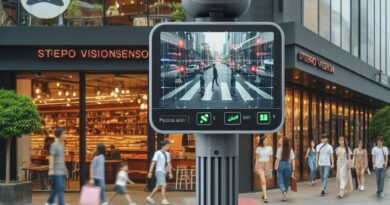

How to Choose the Right People Counter for Your Business (2025 Guide)
Discover how to select the best people counting system for your business.
Compare technologies, key features, pricing, and real use cases in this complete 2025 buyer’s guide.
Introduction: Why Choosing the Right People Counter Matters
In today’s data-driven world, understanding how many people enter, exit, and move through your space is essential. People counting systems use various sensor technologies to capture this data automatically. Whether you manage a retail store, shopping mall, airport, museum, or office building, a people counting system can help you optimize operations, reduce costs, and increase revenue.
But with so many sensor types, brands, and software features available, how do you choose the right people counter for your business?
This guide walks you through the most important factors to consider in 2025 before investing in a people counting solution.
1. Understand Your Business Use Case
Different industries require different features. Start by asking:
- Retail stores: Do you need to measure conversion rates or optimize staff scheduling?
- Shopping malls: Do you need to monitor traffic across multiple entrances?
- Airports & transport hubs: Do you need real-time occupancy and queue monitoring?
- Museums & exhibitions: Do you want to analyze visitor flow through specific zones?
- Smart offices: Do you want to optimize meeting rooms and common spaces?
💡 Pro Tip: Clearly defining your objectives helps narrow down the right technology and providers.
2. Choose the Right People Counting Technology
There are several sensor types—each with strengths and limitations:
| Technology | Best For | Pros | Cons |
|---|---|---|---|
| Infrared (IR) | Small shops, basic counting | Low cost, easy installation | Low accuracy, no directional data |
| Thermal Imaging | High-traffic public areas | Works in low light, mid-cost | Medium accuracy |
| 3D Stereo Cameras | Retail, malls, accurate counting | High precision, tracks direction | Higher cost, more complex installation |
| Time-of-Flight (ToF) | Airports, advanced retail | Compact and highly accurate | Expensive |
| WiFi/Bluetooth | Offices, smart buildings | Passive tracking, scalable | Privacy concerns, less accurate |
| AI Video Analytics | Advanced general use | Detects gender, age groups, heatmaps | High cost, GDPR-sensitive |
3. Accuracy Requirements & Reporting Needs
Before choosing a provider, determine:
- Do you need 99%+ accuracy?
Choose 3D stereo vision or AI-based systems. - Do you want BI integrations or POS connections?
Ensure the system supports real-time data export. - Do you need zone analytics (e.g., dwell time or heatmaps)?
Look for advanced AI systems with heatmap analytics.
🧠 Many vendors provide cloud dashboards with live data and customizable reports.
4. Single Entrance or Multiple Locations?
- Single-entrance store:
Choose a plug-and-play IR or 3D counter. - Shopping mall or franchise with many stores:
Look for multi-site centralized dashboards and enterprise-grade analytics.
5. Budget & ROI Expectations
Approximate pricing in 2025:
- Basic IR counter: $200 – $500
- Thermal or 3D counter: $800 – $2,000
- AI video analytics: $1,000+ per entrance
Additional costs to consider:
- Software subscriptions
- Installation & maintenance
- Integration with existing systems
✅ Choose vendors that offer free trials, demos, or pilot installations.
6. Privacy & Compliance (GDPR / CCPA)
With stricter regulations, ensure your system:
- Does not store or recognize personal identities
- Is GDPR compliant
- Has proper data retention controls
- Provides audit logs and anonymization features
7. Compare Providers and Read Reviews
Leading people counting providers in 2025 include (see our full provider reviews for details):
- RetailNext – Advanced retail analytics
- V-Count – 3D sensors, AI analytics, cloud dashboards
- Xovis – Premium 3D stereo sensors
- FootfallCam – Affordable all-in-one solutions
- Brickstream (Sensormatic) – Scalable enterprise solutions
Conclusion: Choose Smart, Not Just Cheap
The right people counting system is not just about the hardware—it’s about insights, ROI, and how well the solution integrates into your daily operations. By understanding your use case, accuracy needs, privacy requirements, and budget, you can make a strategic investment that benefits your business for years.
Key Takeaways
Compare trusted, GDPR-compliant vendors. comparar características. and find the best match for your business in minutes
Define your goals before choosing a system.
Match sensor technology to your environment.
Evaluate accuracy, reporting needs, and scalability.
Next Steps: Explore More Resources
- Best People Counting Solutions: Top 10 Reviews (2025) — Detailed reviews of every major provider.
- LiDAR vs. 3D People Counters: 2025 Buying Guide — Which sensor technology is right for you?
- Top 20 People Counting Solutions — Broader market overview.
- 3D Sensors & Visitor Tracking: Complete Guide — How 3D sensors work and their benefits.
- KPIs for People Counting Sensors — Which metrics matter most?
- The Future of People Counting & Footfall Analytics — AI, IoT, and trends to watch.
See also: ISO standards for counting systems and GDPR compliance resources for privacy-compliant deployments.