People Counting Solutions Compared: Which Technology Is Right for Your Business?
Whether you manage a retail store, a shopping mall, a museum, or a corporate office, understanding how many people enter and move through your space is crucial for smarter business decisions. But with so many people counting solutions on the market — from basic infrared sensors to AI-powered video analytics — choosing the right one can feel overwhelming. This guide breaks down the most popular people counting technologies, compares their pros and cons, and helps you decide which solution best fits your needs.

Why People Counting Matters for Your Business
Accurate foot traffic data powers a wide range of business improvements. Retailers use it to measure conversion rates and optimize staffing. Facility managers rely on it for HVAC efficiency and space planning. Event organizers need it for safety compliance. Without reliable people counting, you’re making critical decisions based on guesswork.
The right people counting system gives you real-time and historical data on visitor volume, peak hours, dwell times, and traffic patterns — all of which directly impact your bottom line. According to Retail Dive, retailers who leverage foot traffic analytics see measurable improvements in sales conversion and staffing efficiency.
The 6 Main Types of People Counting Technology
1. Infrared Beam Counters
Infrared beam counters are one of the oldest and most affordable people counting methods. A beam of infrared light is placed across an entryway, and the sensor counts every time the beam is broken.
Pros: Low cost, easy to install, minimal maintenance.
Cons: Low accuracy (can’t distinguish direction or multiple people passing simultaneously), easily triggered by carts, bags, or animals.
Best for: Low-traffic, single-entry locations where budget is the top priority.
2. Thermal Imaging Counters
Thermal sensors detect body heat signatures to count people passing underneath. They work overhead and can distinguish between individuals even in dim lighting.
Pros: Privacy-friendly (no images captured), works in all lighting conditions, reasonable accuracy.
Cons: Affected by extreme temperature environments, limited analytics beyond simple counts.
Best for: Retail stores, offices, and venues where GDPR and privacy compliance is a concern.
3. Video-Based People Counters (Standard Camera)
Standard video cameras paired with computer vision software can count people entering and exiting a space. The footage is analyzed in real time or after the fact.
Pros: Moderately accurate, doubles as security footage, scalable.
Cons: Privacy concerns, performance varies with lighting and crowding, requires ongoing software maintenance.
Best for: Businesses that already have CCTV infrastructure and want to add counting capabilities.
4. AI-Powered Video Analytics Counters

The most advanced form of video-based counting, AI-powered systems use deep learning algorithms to detect, track, and count individuals with very high accuracy — often exceeding 98%.
Pros: Highest accuracy, can provide rich analytics (demographics, dwell time, queue length, heatmaps), scalable across multiple locations.
Cons: Higher upfront cost, requires reliable internet connectivity, privacy regulations may apply.
Best for: Large retailers, shopping centers, airports, and businesses seeking deep behavioral insights.
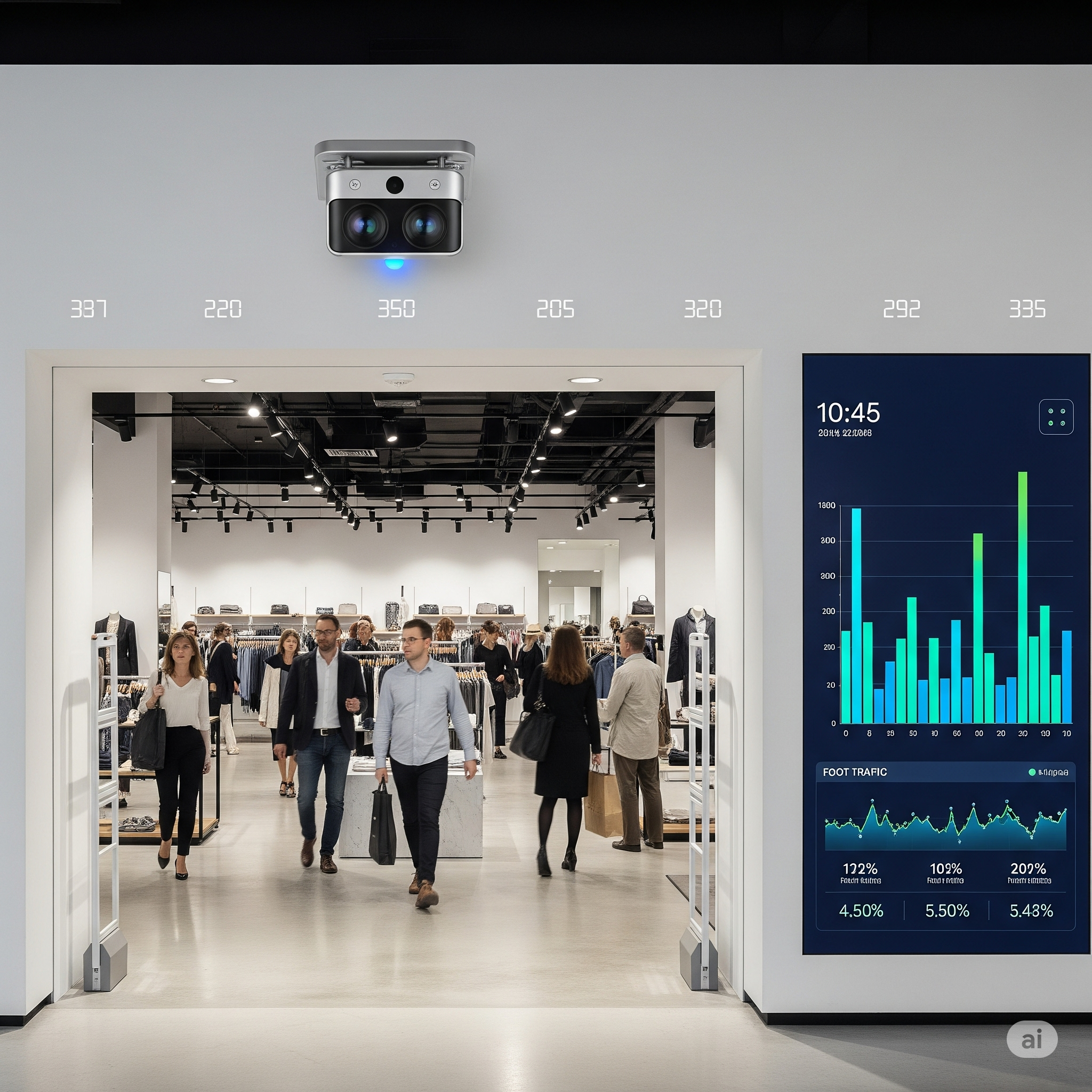
5. 3D Stereo Vision Counters
3D stereo cameras use two lenses to create depth maps, allowing them to accurately distinguish individuals even in crowded conditions. They’re mounted overhead at entrances.
Pros: Very high accuracy (~95–99%), excellent in high-traffic areas, direction detection.
Cons: More expensive than 2D cameras, installation requires proper positioning.
Best for: Shopping malls, transit hubs, and stadiums with high footfall.
6. Wi-Fi and Bluetooth Tracking
Wi-Fi and Bluetooth sensors detect the signals emitted by smartphones to estimate visitor counts and movement patterns.
Pros: Can track repeat visitors, measure dwell time and movement paths, no camera needed.
Cons: Only counts device-carrying visitors (not 100% of people), accuracy varies, strong privacy regulations apply.
Best for: Large venues, trade shows, and businesses already collecting customer data.
People Counting Solutions Comparison Table
| Technology | Accuracy | Cost | Privacy-Friendly | Best Use Case |
|---|---|---|---|---|
| Infrared Beam | Low (60–70%) | $ | Yes | Small shops, single entrances |
| Thermal Imaging | Good (85–93%) | $$ | Yes | Offices, retail, GDPR-sensitive |
| Standard Video | Moderate (80–90%) | $$ | No | Existing CCTV users |
| AI Video Analytics | Excellent (95–99%) | $$$ | Partial | Large retail, malls, airports |
| 3D Stereo Vision | Excellent (95–99%) | $$$ | Yes | High-traffic venues |
| Wi-Fi / Bluetooth | Variable (70–85%) | $$ | No | Events, large venues |
How to Choose the Right People Counting Solution
When evaluating people counting systems, consider these key factors:
- Accuracy requirements: If data-driven decisions are mission-critical, invest in AI or 3D stereo solutions. For basic awareness, infrared or thermal may suffice.
- Budget: Entry-level systems start under $200 per sensor, while enterprise AI platforms can run into thousands per location annually.
- Privacy compliance: Regulations like GDPR and CCPA restrict the use of facial recognition and identifiable data. Thermal and 3D solutions are generally safer.
- Installation environment: Consider ceiling height, lighting conditions, single vs. multiple entrances, and whether you need indoor or outdoor counting.
- Analytics depth: Do you need just a headcount, or do you want heatmaps, conversion rates, and queue analytics? Higher-end systems offer dashboards with full reporting.
- Scalability: If you plan to expand to multiple locations, choose a cloud-connected solution that centralizes data.

Top Industries Using People Counting Solutions
Retail: Foot traffic analytics help retailers measure the effectiveness of window displays, promotions, and store layouts. Conversion rate (visitors vs. buyers) is a key metric driven by people counting data.
Shopping Malls: Mall operators use people counters to report tenant traffic, allocate staff, and benchmark performance across stores and common areas.
Museums and Cultural Venues: Occupancy data helps with visitor experience management, exhibit popularity tracking, and grant reporting.
Corporate Offices: Workplace analytics powered by people counting support hybrid work policies, space utilization reporting, and facility cost optimization. Learn more about office space optimization strategies.
Transportation Hubs: Airports, train stations, and bus terminals use people counters for crowd management, safety compliance, and resource allocation.
Key Metrics You Can Track with People Counters
- Total visitor count: The foundational metric — how many people entered your location over any given period.
- Peak hours and days: Identify when traffic is highest to optimize staffing and inventory.
- Dwell time: How long visitors stay in specific zones, useful for measuring engagement.
- Conversion rate: Ratio of visitors to buyers — a critical retail KPI.
- Bounce rate: How many people enter but leave immediately without exploring.
- Occupancy levels: Real-time capacity monitoring for safety and compliance.
Frequently Asked Questions About People Counting
What is the most accurate people counting technology?
AI-powered video analytics and 3D stereo vision counters are currently the most accurate people counting technologies, achieving accuracy rates of 95–99% even in busy, multi-person scenarios. They are the preferred choice for enterprise deployments where data quality is critical.
Are people counting systems GDPR compliant?
It depends on the technology. Thermal imaging and 3D stereo counters that do not capture identifiable images are generally considered GDPR-compliant. Video-based systems that store footage or use facial recognition require careful privacy impact assessments and clear data governance policies.
How much does a people counting system cost?
Costs vary widely. Basic infrared sensors can cost as little as $100–$300 per unit. Mid-range thermal or 3D stereo systems range from $500 to $2,000 per sensor. Enterprise AI video analytics platforms often involve subscription fees and can cost $2,000–$10,000+ per year per location depending on features and scale.
Can people counters work outdoors?
Yes, several people counting solutions are designed for outdoor use. Thermal sensors and specialized outdoor-rated video cameras can handle varying weather and lighting conditions. Always check the IP rating (e.g., IP65 or higher) when evaluating outdoor people counting hardware.
Final Thoughts: Invest in the Right People Counting Solution

Choosing the right people counting solution comes down to your specific needs: the size of your space, required accuracy, budget, privacy obligations, and the depth of analytics you need. For small businesses on a budget, a simple infrared or thermal counter may be all you need. For large retailers, malls, or transit hubs seeking actionable insights, AI-powered or 3D stereo systems offer the best return on investment.
Whatever your choice, implementing a reliable people counting system is one of the smartest investments you can make in understanding your visitors — and ultimately growing your business. Explore our full range of people counting solutions to find the perfect fit for your location.
Explore More Guides & Reviews
- Best People Counting Solutions: Top 10 In-Depth Reviews (2025) — Full pros, cons, and pricing for the leading platforms.
- LiDAR vs. 3D People Counters: Ultimate 2025 Buying Guide — The two most accurate technologies compared.
- How to Choose the Right People Counter for Your Business — Complete decision-making framework.
- The 2026 Power List: Top 50 Providers Ranked — The most comprehensive provider ranking available.
- People Counting Guide: 3D Sensors & Visitor Tracking (2025)
- Top 30 People Counting System Providers