People Counting Systems: The Complete 2026 Pillar Guide to Sensors, Technology, Vendors & ROI
Quick Answer (TL;DR)
A people counting system is an overhead sensor plus software that counts how many people enter or pass a defined area. In 2026 there are six mainstream technologies: AI 2D cameras (cheapest, 96–98% accuracy), 3D stereo (enterprise default, 98.5–99.7%), LiDAR (best for airports and large spaces, 98–99%), thermal (most privacy-friendly, 95–97%), mmWave radar (best for hidden/outdoor installs, 95–97%) and legacy Wi-Fi probe counting (declining, 70–80%).
Typical pricing: £150–£3,000 per sensor + £20–£80/month software. Typical payback: 2–9 months in retail, 4–14 months in transport and public sector. GDPR: 3D, LiDAR, thermal and radar are inherently anonymous; AI cameras require a DPIA.
We’ve spent the past four years auditing, comparing and writing about every people counting system we can get our hands on. The market has changed a lot since 2022 — break-beam clickers are nearly dead, AI cameras have gone from a luxury to a baseline, and LiDAR has quietly become the safe bet for airports. This page is the long-form guide we wish existed when we started.
If you’re new to the topic: a people counting system is the sensor (plus the software behind it) that tells you how many humans walked into a building, a zone, or past a line. That’s it. The interesting stuff lives in the second-order questions — which sensor for which environment, what accuracy you can actually expect on a Tuesday afternoon with sunlight bouncing off the floor, what it costs to roll out across 50 stores, and which vendors are worth taking a call from.
Below, we go deep on each technology, walk through real costs (with ranges, not invented numbers), map out which industries get value where, and link out to our standalone deep dives. Nothing here is theoretical — if a number looks specific, it’s because we’ve seen it in a quote or a project.
A note from the editor. We update this page whenever a meaningful technology shift happens — last full review was March 2026 after Xovis released its v8 platform and three more LiDAR vendors entered the retail segment. If you spot something out of date, mail us. We read everything.
What Is a People Counting System?
Strip it back and there are two pieces. A sensor sits overhead, usually mounted at an entrance. It watches for humans, draws an invisible line across the doorway, and ticks up a counter every time someone crosses. Behind that sits the software — a cloud dashboard, an API feed, scheduled CSV exports, whatever your team needs to actually use the data. The sensor is the cheap, replaceable bit. The software is where vendors compete.
One thing worth flagging early: “people counter” means different things in different industries. Retailers say “footfall.” Airports say “passenger counting.” Libraries say “visitor counting.” Facilities teams say “occupancy.” Different words, same underlying capability. If you’re trying to learn the field, our Complete Guide and the essentials primer are good companions to this page.
The terms footfall counter, visitor counter, traffic counter, and people counter are used interchangeably across industries. Retailers usually say “footfall,” airports say “passenger counting,” libraries say “visitor counting,” and smart-building managers say “occupancy sensing.” All describe the same fundamental capability — see our Footfall Counting Complete Guide for the retail-specific deep dive.
How People Counting Systems Work
Every counter, regardless of brand or technology, does three things: spots a human, follows them across a line, and writes that event somewhere. The drama is all in the first step. A 2009 break-beam sensor will count a shopping cart as a person. A 2025 3D stereo sensor will ignore a child if you set the height filter to 1.2m, count two people walking abreast as two (not one), and shrug off direct sunlight glaring across the floor. That gap — between 70% accuracy in the bad case and 99.5% in the good case — is essentially the whole story of the industry. We dug into the numbers in our accuracy deep dive.
1. AI Cameras (2D Computer Vision)
This is the workhorse of the modern market. A camera with a neural network running on-device picks out human silhouettes from a 2D feed at 15–30 frames per second. The big win is price — you can get a perfectly usable AI counter for under £400 in 2026, which would have been impossible four years ago. The catch: AI cameras get noticeably worse when light drops below about 50 lux, and they really don’t like shadows from low-angle winter sun across a polished floor. We’ve watched accuracy drop from 97% to 88% on the same store over a single afternoon as the sun moved. Worth knowing before you sign.
2. 3D Stereo Vision Sensors
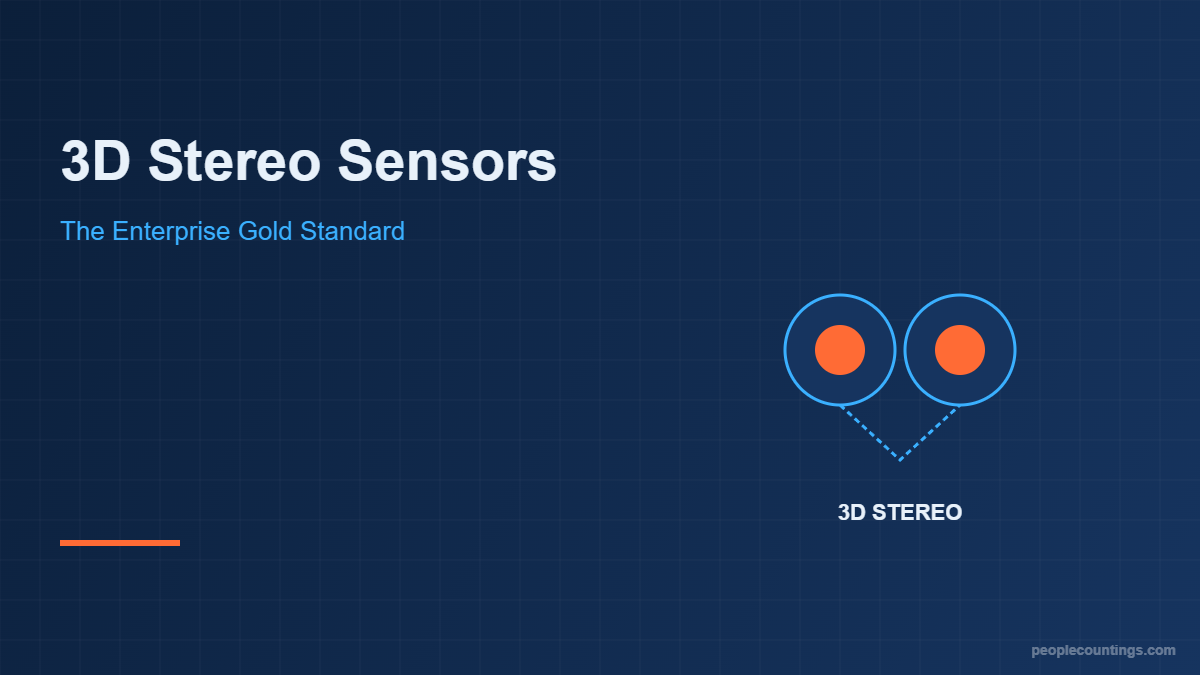
Two lenses, a few centimetres apart, looking down. The software combines the two feeds into a depth map and finds anything tall enough to be a person. Because the decision is based on height rather than appearance, the sensor doesn’t care about clothing colour, shadows, or how warmly your store is lit. It just sees a bump above a threshold. That’s why 3D stereo has been the enterprise default for over a decade and why it still tends to win head-to-head accuracy tests against newer technologies. Expect £300–£900 per unit; expect to pay for it in conversion-rate clarity. Our 3D Sensors Guide and the LiDAR vs. 3D Buying Guide go further.
3. LiDAR Sensors
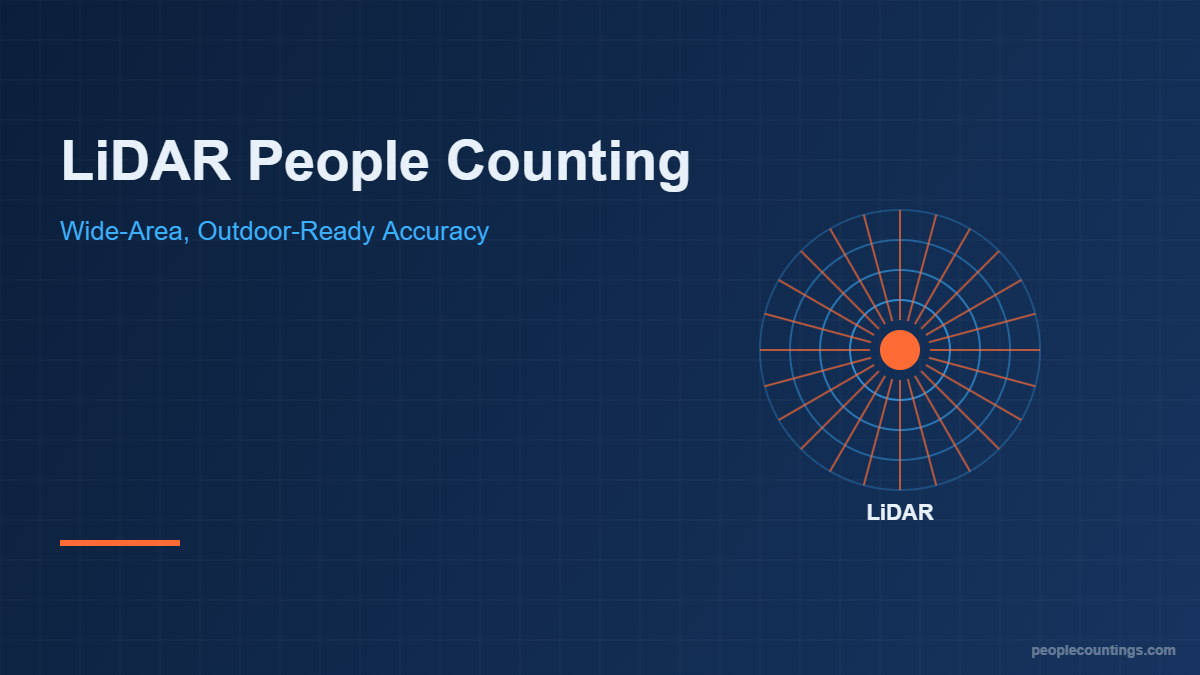
LiDAR fires laser pulses and times the bounce-back. You end up with a 3D point cloud — millions of dots, refreshed 10–25 times a second, mapping the space in front of the sensor. It’s overkill for a shop doorway. It’s perfect for a 30-metre-wide airport gate, a dark train platform, or a stadium concourse where you need to track people moving rather than just count them at a line. The trade-off is price (£800–£3,000) and a slightly more involved install. Our LiDAR vs. 3D comparison walks through where the line falls.
4. Thermal Imaging
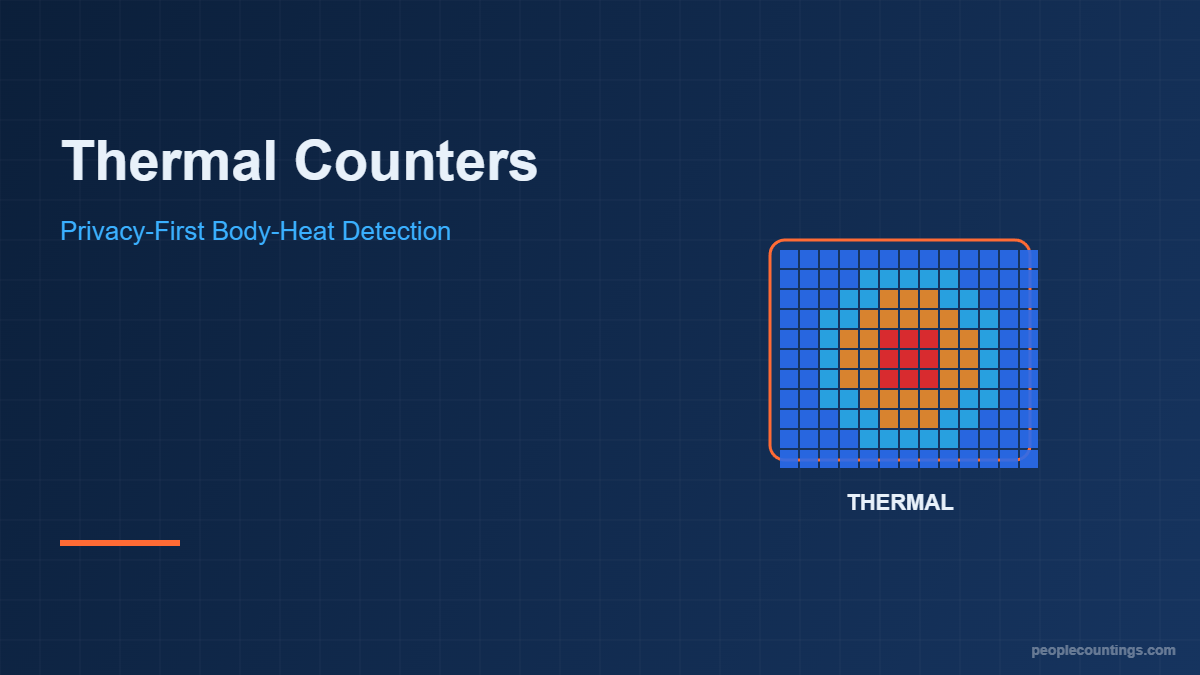
Thermal counters look at heat instead of light. A human body lights up against a colder background in clear contrast, so the sensor counts heat blobs crossing a line. Two things make thermal special. First, the privacy story is the cleanest in the industry — no recognisable image of anyone is ever produced. Second, ambient lighting is irrelevant: midnight, midday, fluorescent, daylight, it doesn’t matter. The flip side is that on a 35°C summer day in a poorly air-conditioned building, the contrast between body and environment narrows and accuracy slips a few points. In most temperate-climate libraries, museums and government offices, that’s a fair trade-off.
5. Radar / mmWave
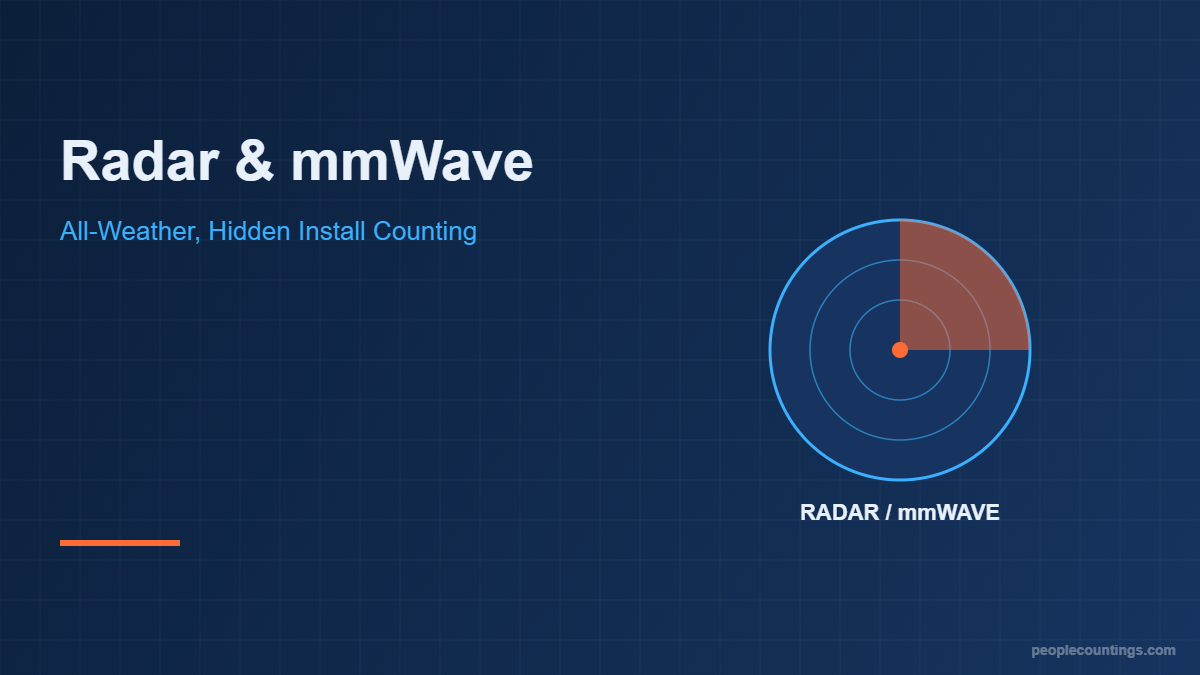
mmWave radar is the new kid. It went mainstream after 2020 once Texas Instruments and Infineon dropped reference designs cheap enough to put in a shop ceiling. Radar’s superpower is that it sees through things — glass, plastic, light architectural finishes. You can hide a radar sensor behind a wood panel and it’ll keep counting. Outdoors it shrugs off rain, snow and fog. The blind spot, literally, is people standing still: hold a pose for half a minute and you’ll quietly fade from the data. That’s why radar is great for flow and queue work, less great for headcount-in-the-room occupancy.
6. Wi-Fi / Bluetooth Probe Counting
Honest take: this technology had its moment between 2015 and 2020 and is now slowly fading. Wi-Fi probe counting works by listening for MAC addresses from nearby smartphones. The problem is that Apple started randomising MACs in iOS 14, Android followed, and roughly half the population now shows up as a fresh “new visitor” every few minutes. Accuracy that used to be 80% is closer to 70% in 2026 and falling. The only place we still recommend Wi-Fi counting is in very large outdoor footprints — high streets, BIDs, big parks — where the margin of error matters less than the cost of installing a real sensor every 30 metres.
For a side-by-side comparison of all six technologies across 50 vendors, see our flagship review: People Counting Sensors Compared 2026 and People Counting Solutions Compared.
Leading Vendors & Solution Providers
The people counting market has matured into a global industry of 50+ specialist vendors plus IP-camera incumbents. Our ranked review series covers them all:
- The 2026 Power List — Top 50 Providers Ranked
- Top 30 Providers — Expanded List
- Top Providers and Their Retail Clients
- Top 10 Providers — Reviews, Pros & Cons
- Top 20 People Counting Solutions
- Comprehensive Comparison of People Counting Brands
- Vendor Spotlight: Hella Aglaia
Industries & Use Cases
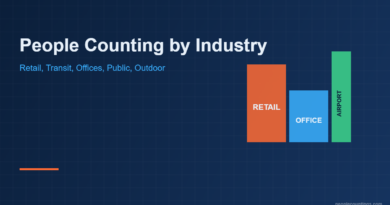
People counting is now standard infrastructure across retail, transportation, smart buildings, public venues, and outdoor smart-city deployments. For an industry-by-industry breakdown, see our People Counting by Industry hub. Headline applications include:
- Retail stores & chains — conversion rate, staffing, marketing ROI — see Retail Solutions Guide
- Shopping malls — tenant reporting, anchor analysis — see Mall KPIs & Integrations and People Counting in Malls
- Airports & public transport — queue management, capacity planning — see People Counters in Transportation
- Museums & libraries — visitor experience, funding reports — see Sensors for Museums
- Smart offices & corporate buildings — desk utilization, HVAC optimization
- Stadiums, events & outdoor venues — safety, dwell heatmaps — see Power of Heatmaps
Key Performance Indicators (KPIs) Unlocked
A people counting system is only as valuable as the decisions it drives. The most powerful KPIs combine visitor counts with sales, staffing, and time data: conversion rate, sales per visitor, average dwell time, peak hour utilization, capture rate, and staff-to-traffic ratio. The full list is in our 20 Essential Retail KPIs guide and our older but still-relevant KPI primer. For a real-world illustration of how two managers used the same data to opposite effect, read A Tale of Two Store Managers and how footfall data skyrockets retail sales.
ROI & Business Case
Retail projects we’ve modelled tend to pay back in two to nine months — sometimes faster — driven by conversion-rate uplifts of five to fifteen percent once managers start staffing to actual demand rather than gut feel. Transport and public-sector deployments run longer, usually four to fourteen months, mostly because the win there is staffing optimisation and protected grant funding rather than direct revenue. Our ROI Calculator & Business Case guide works through three live models (single store, 50-store chain, 200-store enterprise) with the spreadsheet logic exposed so you can rebuild it for your own numbers.
How to Choose the Right System
The decision framework boils down to five questions: (1) What’s your accuracy requirement? (2) What’s your environment — indoor, outdoor, lit, dark? (3) Do you need demographics, dwell time, or just totals? (4) What’s your integration stack (POS, BI, BMS)? (5) What’s your scale — 1 site or 500? Our two buying guides walk through each step:
The Future of People Counting
The next five years will see edge-AI on every sensor, predictive forecasting baked into platforms, GDPR-by-design as table stakes, and tighter convergence with HVAC, lighting, and security under unified IoT dashboards. See our outlook in The Future of People Counting and Footfall Analytics.
Frequently Asked Questions
How accurate are modern people counting systems?
Honestly, it depends on the install as much as the technology. Top-tier 3D stereo and LiDAR get to 98–99.5% in real deployments when they’re mounted properly. AI 2D cameras land at 96–98% in decent light and noticeably less in difficult light. Wi-Fi probe counting sits between 70% and 85% and is gradually getting worse as more phones randomise their MAC addresses. The deep version of this answer lives in our accuracy guide.
How much does a people counting system cost?
Wide range. The cheapest AI camera comes in around £150. An industrial LiDAR unit can be £3,000. Software adds £20–£80 per sensor per month on top, depending on what analytics you turn on. A 50-store retail chain rolling out for the first time usually spends somewhere between £30,000 and £90,000 in year one, all-in.
Is people counting GDPR compliant?
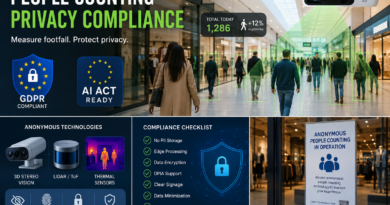
3D stereo, LiDAR, thermal, and radar systems are inherently anonymous — they detect humans without capturing facial images, so they fall outside most personal-data definitions. AI 2D cameras require a Data Protection Impact Assessment (DPIA) and clear signage. Wi-Fi probe counting is the most regulated, requiring explicit lawful basis under GDPR Article 6.
What’s the difference between people counting and occupancy monitoring?
People counting measures flow (entries/exits over time); occupancy monitoring measures presence (how many are inside right now). Most modern systems do both — see our FAQ Guide and 30 Burning Questions FAQ.
Next Steps
Ready to evaluate vendors? Start with the 2026 Power List, then narrow by industry using our Industry Hub, and finally build your business case with the ROI Calculator.
Deep Dive: AI Cameras & Computer Vision
Edge-AI chips collapsed in price between 2021 and 2024 and that single fact reshaped the market. A modern AI camera now pairs a 2–5 megapixel sensor with a neural processing unit good enough to run a YOLO-style person-detection model right on the device, 15 to 30 times a second. Nothing identifiable leaves the box — the camera just publishes anonymous integer counts to a cloud endpoint. Done right, that’s a clean GDPR story.
The reason these dominate small-format retail and quick-service is straightforward: about 80% of the capability of a 3D stereo sensor at roughly half the price. The reason they sometimes burn buyers is mounting. We’ve seen too many cameras installed at 30 degrees off vertical, angled in from a wall to “save on conduit” — and every one of those installs hits the same accuracy wall in the first month. Overhead, 2.5–4.5 metres up, perpendicular to the flow. That’s it. Get that right and you’re competitive with anything; get it wrong and you’ll spend six months wondering why your numbers don’t reconcile.
For numbers we’ve measured in retail conditions, see our 2026 Sensors Comparison.
Deep Dive: 3D Stereo Sensors
3D stereo has held the enterprise spot for more than a decade and still does. Two lenses, calibrated to a few-millimetre tolerance, build a depth map in real time. The software defines a height threshold (1.1m is the usual setting if you want to ignore children, 0.4m if you want to count them) and tracks any object above that line as it crosses the counting boundary. Because the maths happens on depth, the sensor doesn’t care what colour your floor is, whether the autumn sun is glaring through the front window, or whether the visitor is wearing a black hoodie that would have confused a 2D camera.
The published figures from major vendors land between 98.5% and 99.7% in busy shopping-mall entrances with traffic flowing both ways. We’ve validated against the lower end of that in real audits, never lower. The only real downside is field of view — a 3D sensor mounted at 3m typically covers a 3–4 metre doorway and anything wider needs a second unit stitched in. Not difficult, but it bumps the cost. For the proper technology breakdown and a head-to-head with LiDAR, our 3D Sensors Comprehensive Guide is the right next read.
Deep Dive: LiDAR for People Counting
The story of LiDAR in people counting is really the story of the self-driving-car bust. Around 2021, automotive-grade solid-state LiDAR found itself with a glut of supply chasing not enough cars. Sensor vendors pivoted to building automation and the prices that made sense for a £50,000 vehicle suddenly made sense for a 12-foot airport ceiling. Indoor people-counting LiDAR is tuned to a 6–25m range, refreshes 10–25 times a second, and produces a dense point cloud where each person shows up as a tight, coherently-moving cluster of points.
What makes it genuinely different from everything else on this page: LiDAR can track paths, not just count lines. If you want to know how visitors actually move between three entrances of a department store — anonymously, without retaining a single video frame — LiDAR is the only mainstream technology that does it natively. Add in IP67 outdoor ratings and total darkness operation and you can see why it’s becoming the default in airports, transit hubs and flagship retail.
The honest cost picture: £800–£3,000 per sensor plus a platform fee that’s usually heftier than the AI-camera equivalent. The math only works when the value of accurate counts is north of £5,000–£10,000 per location per year. Our LiDAR vs. 3D Buying Guide goes deeper into where the line falls.
Deep Dive: Thermal People Counters
Thermal sensors capture longwave infrared — the 8–14 micrometre band where warm bodies stand out against cooler floors and walls. The output isn’t an image; it’s a low-resolution heat map. Humans show up clearly. Clothing, lighting and partial occlusion don’t move the needle. And critically, no facial detail, no number plate, no readable image is ever produced. That last point is why every library, government building and school we’ve worked with has either specified thermal directly or asked us if they should.
The trade-off is honesty about resolution. A typical thermal counter runs at 80×60 or 160×120 pixels. That’s enough to count humans crossing a line; it’s not enough to do age/gender demographics or detailed path heatmaps. Accuracy also softens when ambient air temperature approaches 35°C — at that point the body-to-room contrast narrows and the sensor has a harder time. For most indoor deployments in the UK, Europe or northern US, you’ll land at 95–97% accuracy for about the price of an entry-level AI camera. That’s a very good deal if privacy matters.
Deep Dive: Radar & mmWave Counting
60 and 77 GHz mmWave radar is the newest mainstream technology on this page. It took off after 2020 when Texas Instruments and Infineon published reference designs that made it cheap to integrate. The interesting property of radar is penetration — it punches through glass, plastic and thin architectural finishes. That opens up installations the other technologies can’t touch: drive-thru lanes, transit shelters, smart-city plazas, and anywhere an architect would rather not see a sensor poking out of the ceiling.
Counting happens on Doppler signatures — moving humans produce a particular radial-velocity pattern that’s easy to distinguish from vehicles or wind-blown signage. Where radar struggles is stillness. A visitor who stops to read a sign for 30+ seconds may slowly drop out of the signature. That’s why we don’t recommend radar for occupancy monitoring (how many are inside right now) but happily recommend it for pure flow work, where it lands at 95–97% in real-world tests.
Integrating People Counting Data with Your Stack
If we had to name the single thing that determines whether a people counting project pays back, it isn’t the sensor brand. It’s whether the count data ever reaches the system where decisions actually get made. We’ve audited deployments where world-class sensors fed a dashboard nobody opened — and far cheaper installs that printed money because the counts pushed straight into the POS, the rota tool and the BI stack. Modern platforms ship native connectors for Shopify, Lightspeed, Oracle Retail and SAP on the POS side; Power BI, Tableau and Looker for BI; Kronos and Quinyx for workforce; Siemens Desigo and Honeywell for BMS; Genetec and Milestone on the security stack. REST and webhooks are table stakes. Check the connector list before you sign.
For shopping-mall operators specifically, the integration discussion deserves its own chapter: tenants need landlord-grade isolation, anchor analyses, and standardized reporting formats. Our dedicated guide People Counting for Shopping Malls: Use Cases, KPIs and Integrations walks through every interface in detail.
Implementation Checklist
- Site survey — map every entrance, ceiling height, lighting condition, and obstruction
- Pilot — install at one location for 30 days and validate accuracy against manual counts
- Mounting — overhead, perpendicular to traffic flow, away from direct sunlight and HVAC vents
- Connectivity — Power over Ethernet (PoE) is standard; cellular fallback for remote sites
- Calibration — confirm counting line position, height filter, and bidirectional logic
- Data validation — run weekly manual audits for the first 90 days
- Integration — push counts to POS, BI, and BMS via API or scheduled CSV
- Training — get store managers reading dashboards before week 4
- Reporting cadence — daily snapshot, weekly trend, monthly executive summary
Privacy, GDPR & Data Ethics
People counting sits in a privacy sweet spot — the data is genuinely useful but, with the right technology choice, is also genuinely anonymous. 3D stereo, thermal, LiDAR, and radar systems do not record video, do not store identifiable features, and do not link counts to individuals. They count humans as objects, not as people with identities.
That said, AI cameras and Wi-Fi probe counters do raise legitimate GDPR/CCPA concerns and should always be deployed with a Data Protection Impact Assessment, transparent signage, and a documented lawful basis. Our outlook piece The Future of People Counting and Ethical Considerations goes deeper on the ethics question, and the 30 Burning Questions FAQ answers the most common compliance queries.
Choosing Between Brands
The vendor landscape splits into four tiers: enterprise specialists (V-Count, Xovis, Irisys, RetailNext, ShopperTrak, FootfallCam), IP-camera incumbents who bundle counting (Axis, Hikvision, Hanwha, Bosch), cloud-native challengers (Aislelabs, Density, Vemco, Hella Aglaia), and Asia-Pacific volume players (Dahua, EasyCounter, Acorel). Pick from the right tier for your use case: enterprise specialists for multi-country retail, IP-camera incumbents when you’re already standardised on their VMS, cloud-native challengers for smart-office and analytics-first deployments, and APAC volume players when unit economics are the dominant criterion.
For brand-level pros, cons, and pricing, see our Comprehensive Comparison of People Counting Brands, Top 10 Reviews, and the flagship All-50 Sensors Comparison.
How long does a people counting deployment take?
A single store can be live in a day. A 50-store chain typically takes 6–10 weeks including site surveys, hardware shipping, installer scheduling, and integration testing. Enterprise rollouts of 500+ sites run 6–12 months.
Can I install sensors myself?
For single-camera AI counters and thermal units — yes, most vendors offer self-install kits with PoE injectors and step-by-step apps. For 3D stereo and LiDAR, professional installation is strongly recommended because calibration is non-trivial and accuracy depends on precise mounting.
What ongoing maintenance does a people counting system need?
Very little: a sensor wipe every 3–6 months, a software update push from the vendor cloud, and a quarterly accuracy spot-check against manual counts. Most enterprise vendors offer remote health monitoring and proactive replacement under SLA.
A Short History of People Counting
People counting began in the early 1970s with horizontal infrared break-beam counters installed at department-store entrances. Those first-generation devices counted every interruption of the beam, so a shopper with a pram registered as multiple people and two friends walking abreast counted as one. Accuracy was rarely better than 70%, but the data was still good enough to revolutionise retail staffing decisions for the first time.
The 1990s brought thermal pixel arrays and the first overhead video counters using simple frame-differencing algorithms. Accuracy jumped to 85–90% and shopping-mall operators became the first to deploy counters as a standardised reporting infrastructure across hundreds of stores. The 2000s introduced stereo vision; the 2010s brought IP-camera bundling and cloud platforms; and the 2020s have been defined by edge AI, LiDAR adoption, and the shift toward privacy-by-design architectures.
Edge AI and the Next Five Years
Three trends will define the 2026–2030 cycle. First, edge AI inference will absorb every analytics layer that today runs in the cloud — counts, demographics, dwell, queue length, group detection — meaning sensors will ship raw events rather than raw video, eliminating bandwidth costs and most privacy concerns simultaneously. Second, multi-sensor fusion will become standard: LiDAR plus thermal plus AI camera covering one space and cross-validating each other’s counts, pushing accuracy past 99.9% even in adverse conditions. Third, predictive analytics will move from a vendor add-on to a default: tomorrow’s footfall forecast, staffing recommendation, and HVAC pre-cooling schedule will be auto-generated from the previous 90 days of data.
The strategic implication for buyers in 2026 is to pick platforms with strong APIs and open data export, because the sensor layer will commoditise faster than the analytics layer. For a longer outlook on technological and ethical evolution, see The Future of People Counting and Footfall Analytics.
Glossary of People Counting Terms
- Footfall — the count of people entering a defined space over a defined period
- Conversion rate — transactions divided by footfall, expressed as a percentage
- Capture rate — entries divided by passers-by (requires a sensor on the corridor as well as the doorway)
- Dwell time — average minutes a visitor remains within a counted zone
- Occupancy — the number of people currently inside a space (entries minus exits)
- Heatmap — a visual representation of dwell or movement density across a floorplate
- Bidirectional counting — separate in/out counts at the same line, required for accurate occupancy
- Edge AI — neural-network inference performed on the sensor rather than in the cloud
- PoE — Power over Ethernet, the standard way to power and connect modern people counters
- DPIA — Data Protection Impact Assessment, required under GDPR for any system processing personal data
Continue Reading
This pillar is part of a wider library on PeopleCountings.com. Browse our complementary deep-dives to go further: People Counting by Industry hub, Complete Guide 2026, Footfall Counting Guide, Top 50 Power List, ROI Calculator, 20 Retail KPIs, and our Ultimate FAQ Guide.
Real-World Use-Case Snapshots
Fashion chain, 120 stores, Europe. Their old break-beam counters were under-reporting traffic by about 18% on a typical Saturday — group entries were counting as one. They swapped to 3D stereo at every doorway, plumbed the counts into the POS for live conversion, and in six months saw average conversion lift by 11%. Payback hit in month four. The dataset also exposed two locations that simply weren’t drawing the footfall to justify their rent. Both got subleased the year after, freeing up around £180,000 a year.
Regional airport, eight million passengers a year. Eight ceiling-mounted LiDAR units across security and immigration. The operations team got real-time queue length and wait-time numbers for the first time and started rebalancing staff between lanes the way an air-traffic controller rebalances runways. Peak wait at security dropped from fourteen minutes to seven. The commercial team then used the same dwell data to push concession rents up at the next renewal — a side effect nobody had budgeted for.
National library service, 24 branches. Thermal counters at every branch entrance, integrated with the library system. Reported visitor numbers actually went up by 7% — the old clickers had been quietly undercounting for years. The verified totals went into a £2.4m central-government funding renewal application that came back approved. For deeper reading on similar deployments, see our Museums Guide.
Get Started
If you’re early in your research, start with our buying guide and the 30 Burning Questions FAQ. If you already know which technology you need, jump to our Top 50 Power List to shortlist vendors. If you need to build the business case internally, our ROI Calculator will give you a defensible model in a single afternoon.