GDPR & AI Privacy Compliance in People Counting: How to Measure Footfall Without Violating Data Laws (2026 Guide)
As retailers, shopping malls, airports, smart offices, and public venues increasingly rely on AI-powered people counting systems, privacy compliance has become just as important as counting accuracy.
Today’s buyers aren’t only asking:
- How accurate is the sensor?
They’re also asking:
- Is it GDPR compliant?
- Does it record faces?
- Can it identify visitors?
- Will this create legal risks under the EU AI Act?
Fortunately, modern anonymous people counting technology has evolved significantly. Most enterprise-grade solutions are specifically designed to provide valuable occupancy and footfall analytics without collecting personally identifiable information (PII).
This guide explains how today’s technologies comply with privacy regulations and what organizations should verify before purchasing a people counting solution.
Why Privacy Matters More Than Ever
Retail analytics has become increasingly sophisticated.
Businesses want to understand:
- Visitor traffic
- Conversion rates
- Queue lengths
- Occupancy levels
- Customer flow
- Heatmaps
- Dwell times
At the same time, regulations such as:
- GDPR (Europe)
- CCPA (California)
- UK GDPR
- EU AI Act
- Various national privacy laws
place strict limitations on collecting and processing personal data.
For procurement teams, privacy compliance is now a key requirement alongside accuracy, scalability, and ROI.
Do People Counters Record Faces?
Short answer: Usually, no.
Modern enterprise people counting systems are designed to count individuals rather than identify them.
Unlike CCTV security systems, dedicated people counters typically process information such as:
- anonymous object detection
- depth information
- body movement
- occupancy counts
- trajectories
- aggregated statistics
instead of storing facial images or personal identities.
The exact approach depends on the sensor technology.
How Modern People Counting Sensors Protect Privacy
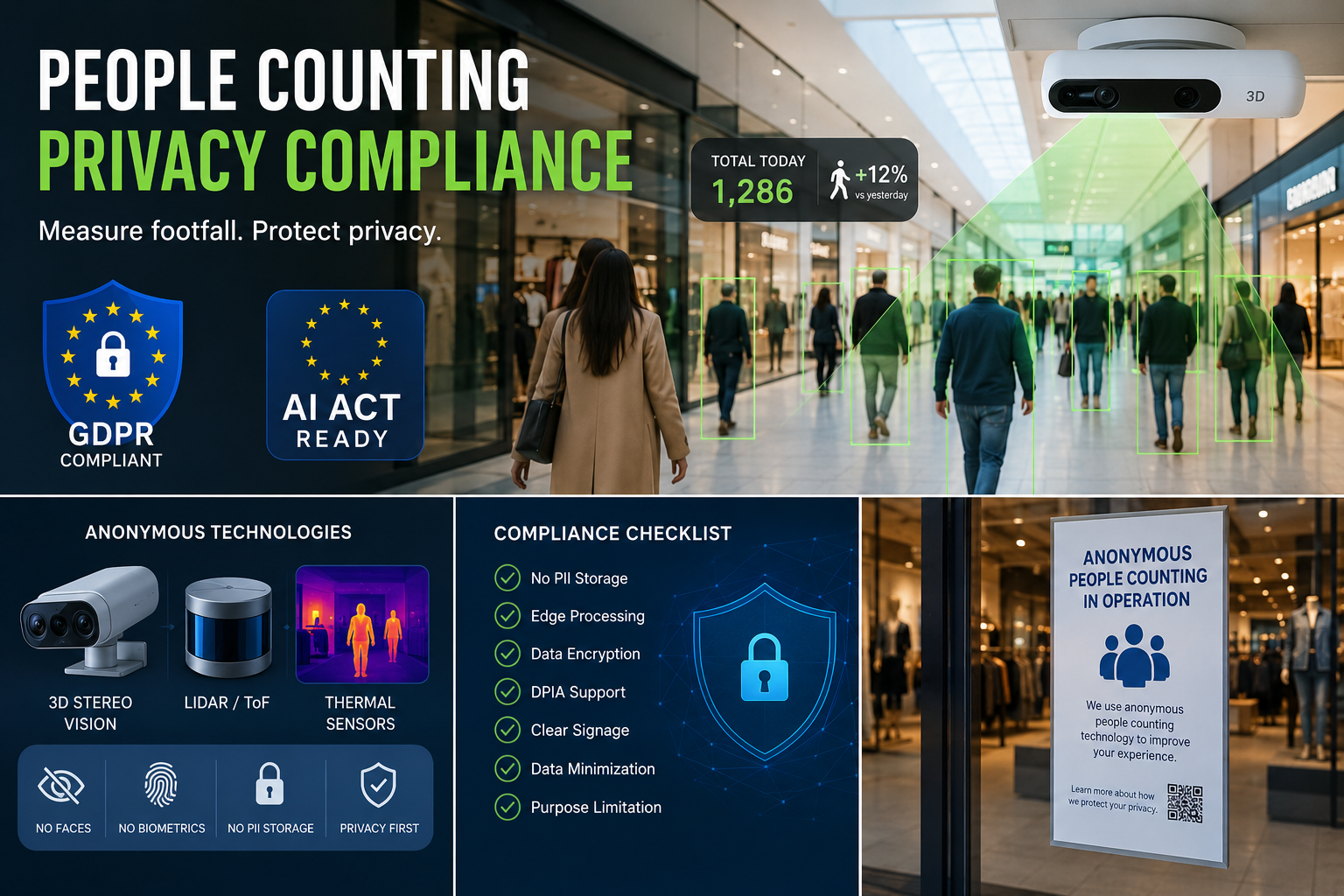
1. 3D Stereo Vision
3D stereo vision sensors use two lenses to calculate depth.
Instead of relying on detailed RGB imagery, they generate depth information that identifies human-shaped objects while minimizing personal identification.
Advantages include:
- High counting accuracy
- Works in changing lighting conditions
- Limited personal data collection
- Ideal for retail entrances
Many enterprise vendors process this information directly inside the sensor, meaning raw imagery never leaves the device.
2. LiDAR & Time-of-Flight (ToF)
LiDAR (Light Detection and Ranging) measures distance using laser pulses.
Instead of capturing photographs, LiDAR creates anonymous 3D point clouds representing object locations.
Because there are no facial details, LiDAR is one of the most privacy-friendly technologies available.
Benefits include:
- Zero facial recognition capability
- Excellent accuracy
- Reliable occupancy monitoring
- Suitable for airports, offices, and industrial facilities
3. Thermal Sensors
Thermal people counters detect heat signatures rather than visible images.
Since only temperature differences are measured, individual identities cannot normally be determined.
Thermal technology is commonly used for:
- Occupancy monitoring
- Washroom counting
- Smart buildings
- Energy optimization
- Public transportation
4. AI Video Analytics with Edge Anonymization
Some advanced systems use AI cameras while protecting privacy through edge computing.
Instead of uploading video streams to the cloud:
- AI detects people locally.
- Personal details are removed.
- Video may be discarded immediately.
- Only anonymous counting metadata is transmitted.
Common techniques include:
- face blurring
- pixelation
- body abstraction
- metadata-only transmission
- on-device processing
This significantly reduces privacy risks compared to traditional surveillance systems.
GDPR Compliance Checklist for Buying Teams
When evaluating a people counting vendor, procurement teams should ask the following questions.
✔ Does the system store Personally Identifiable Information (PII)?
The safest solutions store:
- anonymous counts
- occupancy values
- timestamps
- statistical metadata
instead of:
- facial images
- names
- identities
- biometric templates
✔ Is processing performed on the edge?
Edge processing means data is analyzed inside the sensor before transmission.
Advantages include:
- reduced cybersecurity risk
- lower bandwidth
- improved GDPR compliance
- less cloud exposure
✔ Is encryption used?
Verify:
- encrypted communications
- encrypted cloud storage
- secure firmware updates
- access controls
- audit logs
✔ Does the vendor provide documentation?
Enterprise vendors should offer documentation covering:
- GDPR guidance
- privacy whitepapers
- data processing information
- security architecture
- retention policies
✔ Is a Data Protection Impact Assessment (DPIA) supported?
For many public installations, organizations perform a Data Protection Impact Assessment (DPIA) before deployment.
A typical DPIA evaluates:
- purpose of processing
- data collected
- legal basis
- privacy risks
- mitigation measures
- retention period
Vendors should provide sufficient technical information to support this assessment.
Store Signage: Do You Need to Inform Visitors?
In many jurisdictions, organizations should clearly inform visitors that analytics technologies are being used.
Typical signage may include:
- occupancy monitoring in progress
- anonymous visitor analytics
- purpose of data collection
- privacy policy reference
- contact information
Requirements vary depending on local regulations, the technology used, and whether any personal data is processed. Organizations should consult their legal or privacy advisors for deployment-specific guidance.
GDPR vs Traditional CCTV
| Traditional CCTV | Modern People Counter |
|---|---|
| Security monitoring | Footfall analytics |
| Records identifiable images | Counts anonymous objects |
| May retain video for weeks | Often stores only aggregated statistics |
| Higher privacy obligations | Lower privacy risk when configured correctly |
| Often requires stricter governance | Typically designed for analytics rather than identification |
Vendor Compliance Comparison (Overview)
Note: Capabilities vary by product model, firmware version, and deployment configuration. Buyers should verify current certifications, documentation, and compliance features directly with each vendor during procurement.
The EU AI Act and People Counting
The EU AI Act introduces a risk-based framework for AI systems.
Most anonymous people counting applications used for occupancy analytics and footfall measurement are generally considered lower risk than systems designed for biometric identification or facial recognition.
However, organizations should evaluate:
- intended use
- deployment environment
- AI functionality
- biometric capabilities
- data governance
- human oversight requirements
The regulatory landscape continues to evolve, making ongoing compliance reviews important.
Best Practices for Privacy-First Deployments
Organizations implementing people counting systems should:
- Choose sensors designed for anonymous analytics.
- Prefer on-device (edge) AI processing.
- Avoid unnecessary video storage.
- Limit data retention periods.
- Encrypt communications.
- Conduct DPIAs where appropriate.
- Inform visitors through clear signage where required.
- Work with vendors that provide transparent compliance documentation.
- Regularly review privacy settings after firmware updates.
Frequently Asked Questions
Are people counting systems GDPR compliant?
Many modern people counting systems can be deployed in a GDPR-compliant manner when they process anonymous data, minimize personal information, and are configured appropriately. Compliance depends on the overall deployment, governance, and applicable laws.
Do people counters recognize faces?
Most dedicated people counting sensors do not perform facial recognition. Their purpose is to count visitors and measure occupancy rather than identify individuals.
Is LiDAR better for privacy?
LiDAR is widely regarded as one of the most privacy-friendly sensing technologies because it measures distance and generates point clouds rather than detailed visual images.
Can AI cameras be privacy compliant?
Yes. AI cameras that perform on-device processing, anonymize video, and transmit only aggregated metadata can significantly reduce privacy risks compared with traditional video surveillance systems.
Final Thoughts
Privacy and analytics no longer need to compete.
Modern GDPR-compliant footfall counters demonstrate that organizations can gain actionable business intelligence while respecting visitor privacy. By selecting technologies that emphasize anonymization, edge processing, and transparent governance, businesses can improve operations without introducing unnecessary legal risk.
As regulations continue to evolve, procurement teams should evaluate privacy features with the same rigor they apply to counting accuracy, integration capabilities, and return on investment.