People Counting for Libraries & Universities: Measuring Visits, Occupancy and Space Use (2026)
Libraries are among the busiest public buildings in any city or campus, yet many still rely on an old gate counter, a clicker or a once-a-year headcount to measure use. Those numbers are reported to funders, used to set opening hours and quoted in budget negotiations. Modern people counting for libraries and universities gives accurate visitor numbers, live occupancy and space-use insights that turn the library’s value into hard evidence.
Why Libraries Count Visitors
- Funding and reporting – visit counts are a core statistic in library performance reports and national surveys, and they directly support budget requests.
- Opening hours – hourly traffic shows whether extending evening or weekend hours is worth it.
- Staffing – schedule help-desk and shelving staff around real peaks.
- Space planning – find out which study rooms, quiet floors and makerspaces are overused or ignored.
- Live occupancy – show students how full each floor is before they walk across campus, especially during exam season.
The Problem With Traditional Gate Counters
Many libraries count with infrared beams built into security gates. They are cheap and simple, but:
- Groups walking side by side are counted as one person.
- Many only count in one direction, so occupancy is impossible.
- Staff often divide the number by two to estimate visits, an approximation that hides errors.
- Data sits in the gate’s display and is copied by hand into spreadsheets.
Overhead sensors fix these issues, counting direction and groups accurately and sending data automatically to a dashboard.
Choosing the Right Technology
| Space | Recommended technology | Why |
|---|---|---|
| Main entrances | Overhead 3D stereo or ToF | Bidirectional, accurate with groups, anonymous |
| Large atriums and reading halls | LiDAR | Wide coverage, works in any lighting |
| Group study rooms | Thermal or radar sensors | Room occupancy without cameras |
| Individual study desks | Under-desk PIR sensors | Low cost presence data at scale |
| Whole campus trends | Wi-Fi analytics | Uses existing network, good for rough patterns |
Metrics Every Library Should Track
- Total visits – daily, weekly, monthly and annual entries.
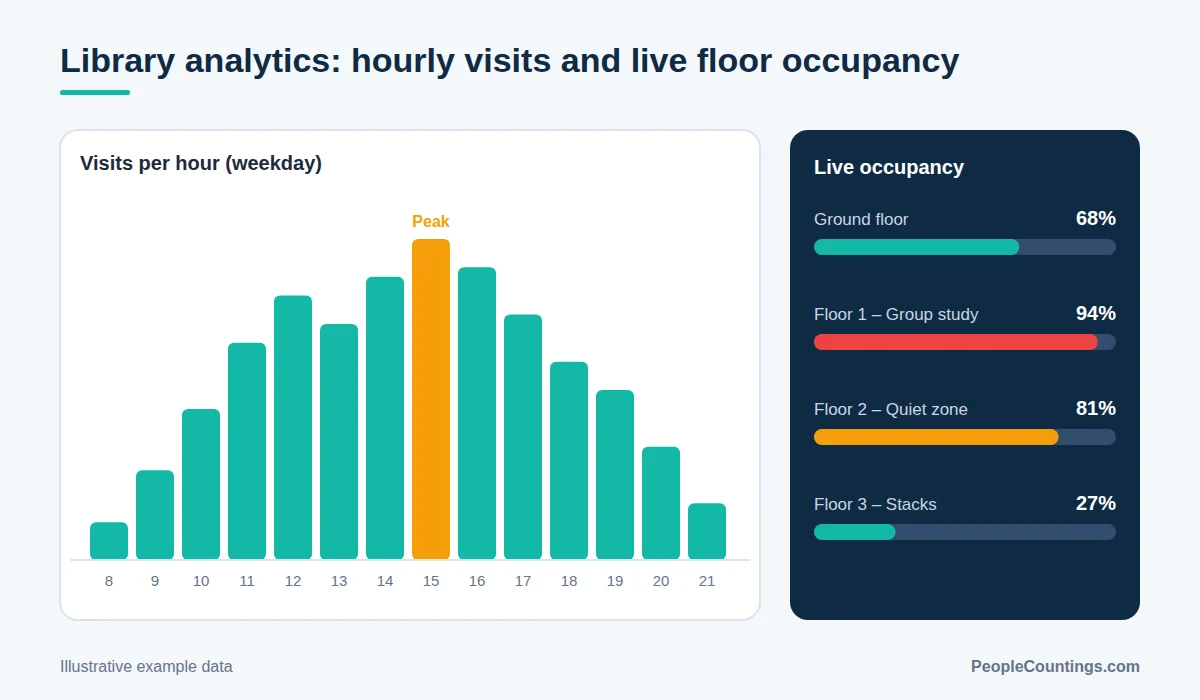
- Hourly traffic profile – the basis for opening hours and staffing.
- Peak occupancy – the highest number of people inside at once.
- Floor and zone occupancy – which areas fill up first.
- Room utilization – booked vs. actually used study rooms.
- Average dwell time – how long visitors stay, a signal of how the library is used.
- Program attendance – events, workshops and classes.
University Campus Use Cases
The same approach extends beyond the library:
- Lecture halls – compare attendance with timetabled capacity to schedule rooms more efficiently.
- Dining halls and cafés – show live busyness and plan food production.
- Sports centers – manage gym capacity and show live availability.
- Student services – reduce queues at enrollment and advice desks.
- Energy – link occupancy to HVAC so empty buildings are not heated or cooled.
See more sector examples in our people counting by industry hub.
Live Occupancy Displays
One of the most popular features with students is a live “how busy is it?” display on the library website, app or screens at the entrance. It reduces wasted trips, spreads demand across floors and buildings, and makes the counting program visible as a service rather than surveillance.
Privacy for Public Institutions
Libraries have a strong tradition of protecting user privacy. Choose sensors that never record identifiable images, process data on the device and only send anonymous counts. Publish a short notice explaining what is counted and why. Our GDPR and privacy compliance guide explains best practices.
Frequently Asked Questions
How much does a library people counter cost?
Simple beam counters are low-cost, while overhead 3D or LiDAR sensors cost more per entrance but deliver far more accurate, automated data. Total cost depends on the number of entrances, zones and software features.
Can a people counter replace the security gate counter?
Yes. Overhead sensors work alongside existing security gates and usually provide more accurate bidirectional counts.
Do people counters count staff?
By default they count everyone. Libraries can exclude staff through separate staff entrances, scheduled adjustments or tag-based exclusion offered by some vendors.
Can the data be exported for annual statistics?
Most platforms export to CSV or Excel and offer APIs, which makes annual reporting much faster than manual tallies.
Turn Footfall Into Evidence
Accurate visitor and occupancy data helps libraries and universities defend budgets, set the right opening hours and design spaces students want to use. Compare vendors in our 2026 Power List or request a free quote to find a solution that fits your campus.