Wi-Fi & Bluetooth People Counting vs Overhead Sensors: Accuracy, Privacy and Cost Compared (2026)
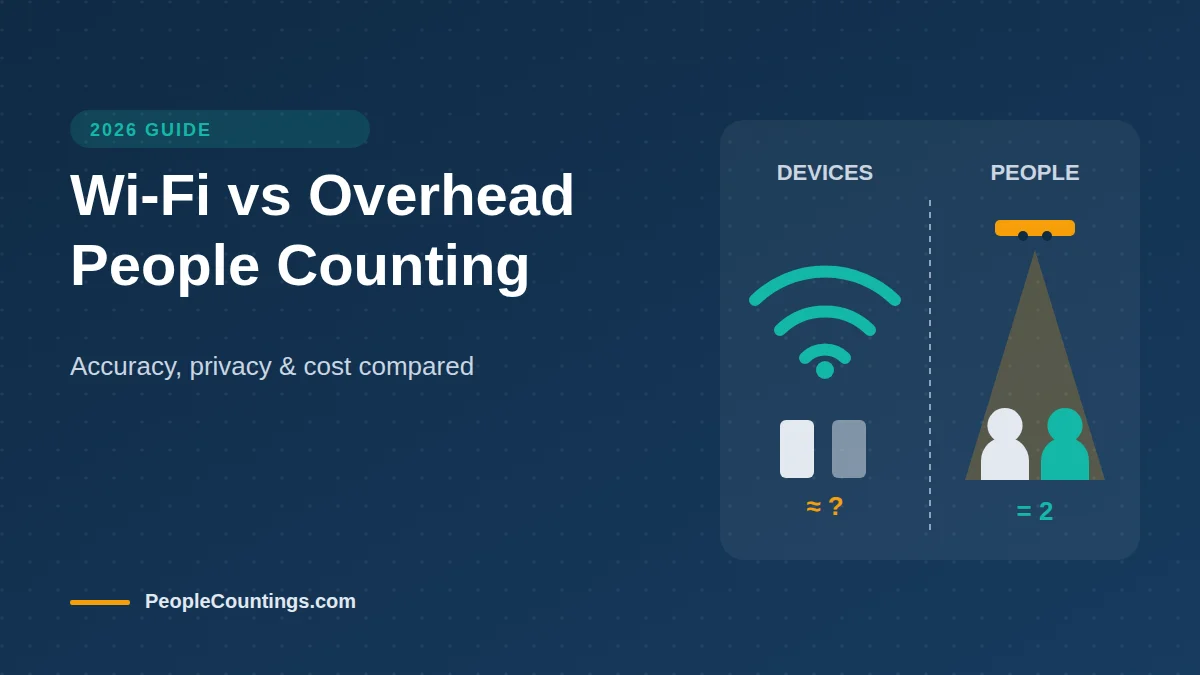
“Can’t we just use our Wi-Fi to count people?” It is one of the most common questions buyers ask, because the network is already installed and the idea of counting for free is attractive. The honest answer: Wi-Fi and Bluetooth analytics are useful for some jobs, but they measure devices, not people. This article compares Wi-Fi and Bluetooth people counting with overhead sensors on accuracy, privacy, cost and use cases so you can choose the right tool, or combine both.
How Wi-Fi and Bluetooth Counting Works
Smartphones regularly send signals to discover networks and nearby devices. Wi-Fi access points and Bluetooth beacons or scanners can detect these signals, estimate how many devices are nearby and, with several receivers, approximate their location. Analytics software then converts device counts into estimated visitor numbers, dwell times and repeat-visit rates.
How Overhead Sensors Work
Overhead people counters – 3D stereo vision, Time-of-Flight, thermal and LiDAR – are mounted above entrances or zones. They detect the physical shape or heat signature of each person crossing a virtual line and record direction, producing in/out counts and occupancy. Processing usually happens on the device, and only anonymous counts are sent to the cloud.
Head-to-Head Comparison
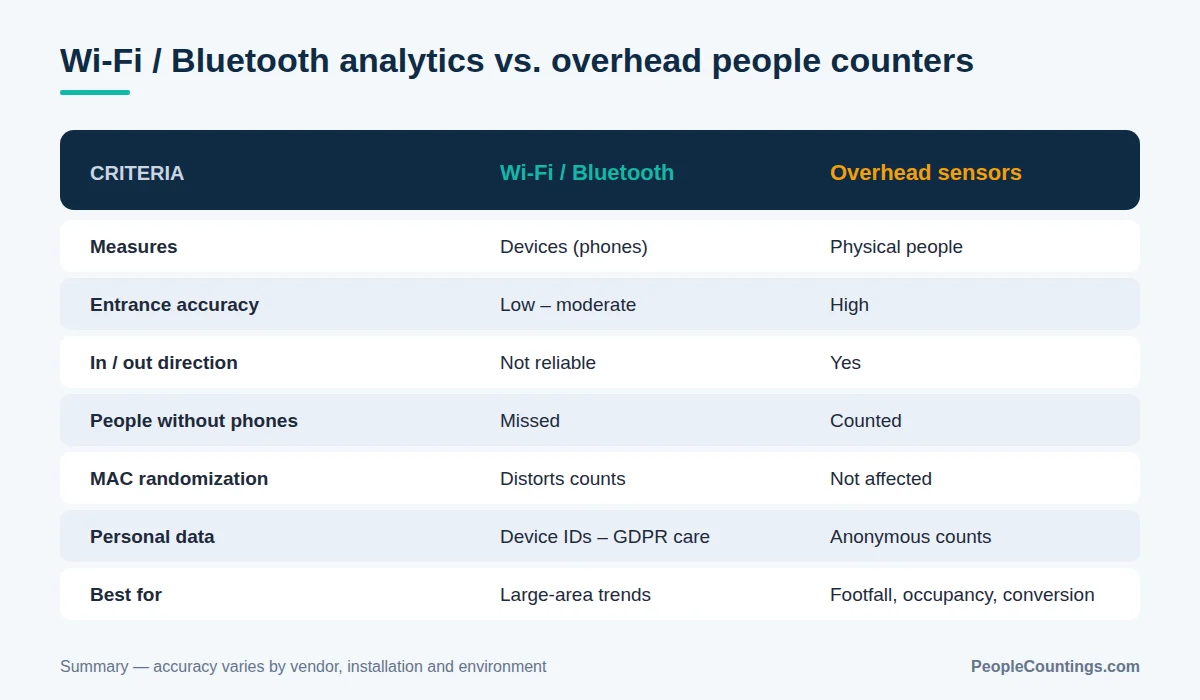
| Criteria | Wi-Fi / Bluetooth analytics | Overhead sensors (3D, ToF, LiDAR, thermal) |
|---|---|---|
| What is measured | Devices with radios switched on | Physical people |
| Entrance count accuracy | Low to moderate; needs calibration | High; commonly specified in the high 90s % |
| Direction (in/out) | Not reliable | Yes |
| Children, people without phones | Missed | Counted (filters configurable) |
| Dwell time and repeat visits | Possible, with limits | Dwell via zones; repeat visits not tracked |
| Coverage | Large areas with existing infrastructure | Defined entrances and zones |
| Hardware cost | Low if network exists | Per-sensor cost plus installation |
| Privacy | Processes device identifiers; needs careful handling | Anonymous counts, no personal data when edge-processed |
The MAC Randomization Problem
Device-based counting used to rely on each phone’s unique hardware (MAC) address. Modern iOS and Android versions randomize these addresses when scanning and, increasingly, per network. As a result:
- One phone can look like several devices, inflating counts.
- Returning visitors become hard to recognize, weakening repeat-visit analysis.
- Vendors must apply statistical models, which adds uncertainty.
Wi-Fi analytics still reveals useful trends, but it is rarely accurate enough for conversion rate or occupancy limits.
Privacy and GDPR
Device identifiers, even hashed, can be treated as personal data under GDPR and similar laws, so Wi-Fi tracking requires a lawful basis, transparency and often signage or consent. Overhead sensors that only output counts and never store images avoid processing personal data in the first place. Read our GDPR people counting guide for details.
When to Use Each
Choose overhead sensors when you need:
- Accurate footfall for conversion rate and sales per visitor.
- Live occupancy for safety limits or capacity displays.
- Staffing plans based on reliable hourly traffic.
- Data you can report to landlords, tenants or funders.
Choose Wi-Fi / BLE analytics when you need:
- Rough trends across a large campus, mall or venue at minimal cost.
- Approximate dwell time and movement between zones.
- Indicators of repeat visits, accepting reduced accuracy.
Best of both: a hybrid approach
Many shopping centers and campuses use overhead sensors at entrances as the “ground truth” and Wi-Fi analytics inside for movement patterns. The accurate entrance counts can calibrate the device-based estimates. Learn more in our shopping mall people counting guide.
Cost Considerations
Wi-Fi analytics looks cheaper because hardware already exists, but count accuracy affects every metric built on top of it. A conversion rate calculated on inflated or deflated footfall leads to wrong decisions about staffing, marketing and store performance. Overhead sensors cost more upfront, yet typically deliver a faster, more defensible return. Our ROI guide shows how to model it.
Frequently Asked Questions
Is Wi-Fi people counting accurate?
It is suitable for trends, not precise counts. Accuracy depends on how many visitors carry phones with radios enabled, MAC randomization and calibration.
Can Bluetooth beacons count people?
Beacons mainly interact with apps that have permission. Bluetooth scanners can detect nearby devices, with similar limitations to Wi-Fi.
Which method is best for retail conversion rates?
Overhead entrance sensors, because conversion depends on accurate visitor counts and direction.
Can I combine both technologies?
Yes. A hybrid setup uses accurate entrance sensors for counts and device analytics for movement inside large spaces.
The Bottom Line
Wi-Fi and Bluetooth analytics count devices; overhead sensors count people. If decisions depend on the numbers, measure the people. Compare technologies in our people counting technology comparison, explore the top 50 providers, or request a free quote.