Top 10 Retail Heatmap Solutions in 2026 (In-Depth Reviews & Comparison)
Retailers can no longer rely on gut feel to decide where a promo table should go, which aisle gets the most foot traffic, or why shoppers walk past an end-cap without stopping. That is the job of a retail heatmap solution: software that turns anonymous sensor or camera data into color-coded maps showing exactly where customers go, pause, and linger inside a physical store. The best platforms pair that visualization with dwell-time, conversion, and staffing data so merchandising and operations teams can make decisions backed by evidence instead of guesswork.
We compared the leading vendors in the in-store analytics space and ranked the 10 best retail heatmap solutions for 2026, based on sensor technology, accuracy, privacy compliance, ease of integration, and how deep each platform’s heatmap and customer-journey features actually go.
TL;DR: For the most accurate, feature-complete platforms, go with Xovis, Vemco Group, or RetailNext. If you want camera-free, privacy-first tracking, Ariadne, Density, and Scanalytics skip cameras entirely. Budget-conscious retailers who want to own their hardware outright should look at Milesight. See the full comparison table below for sensor technology, camera-free status, and best-fit use case across all 10 providers.
What to Look for in a Retail Heatmap Solution
- Sensor technology — 3D stereo vision, Time-of-Flight (ToF), radar, thermal, or floor-pressure sensors each trade off accuracy, privacy, and installation cost differently.
- Privacy and compliance — look for on-device, anonymous processing and GDPR-readiness, especially important across the EU, UK, and Turkey (KVKK).
- Zone and dwell-time analytics — a true heatmap breaks the floor into zones and reports dwell time, not just raw footfall counts.
- POS and staffing integration — the most actionable platforms tie heatmap data to conversion rate, sales, and staff scheduling.
- Multi-store benchmarking — useful for chains that want to compare layouts and campaigns across locations.
Top 10 Retail Heatmap Solutions in 2026
1. Xovis
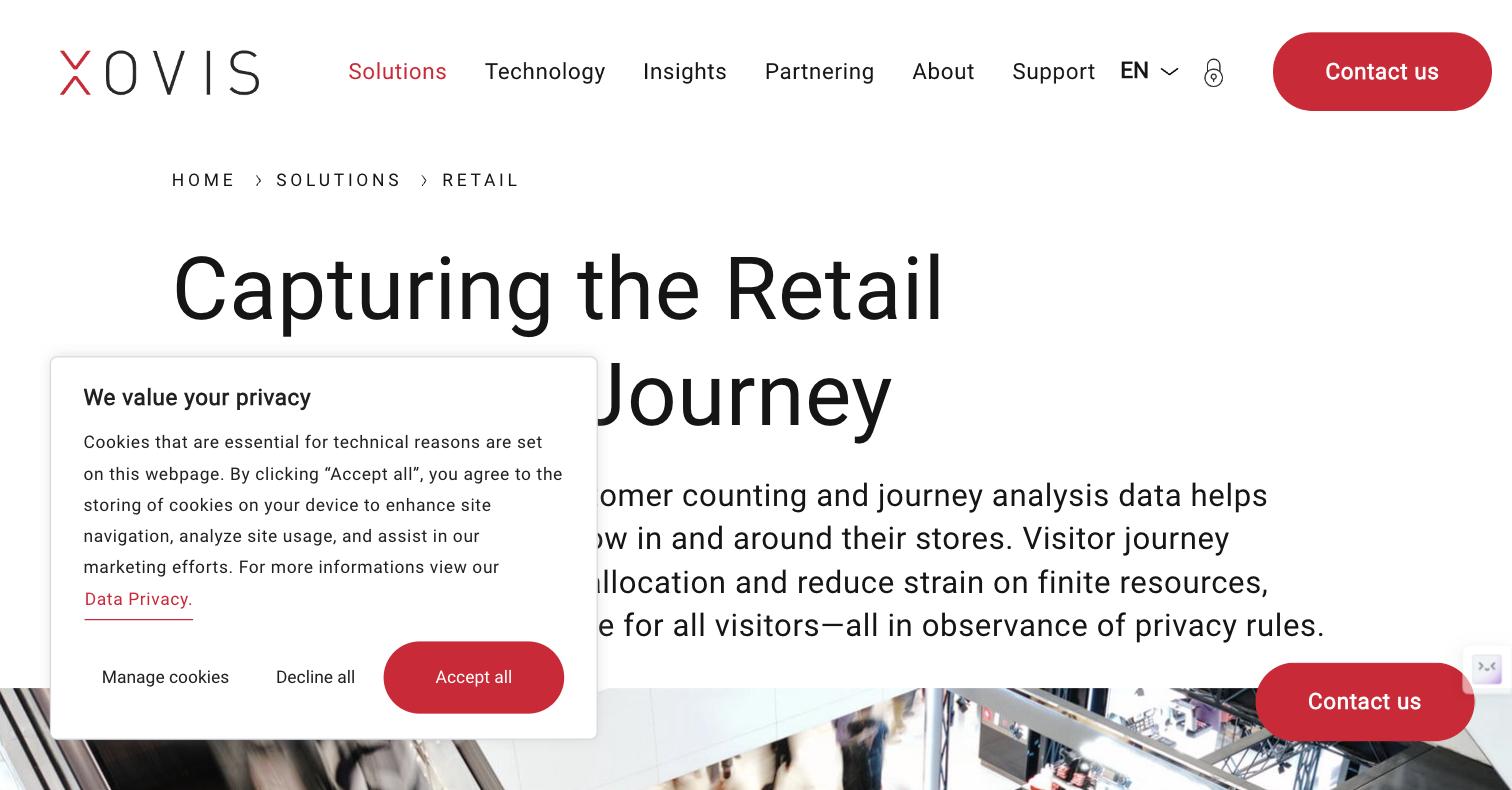
Swiss sensor specialist Xovis built its reputation on high-accuracy 3D overhead sensors, and its retail solution extends that hardware into detailed heat maps of “zones of interest.” The platform tracks customer counting and full visitor-journey data around a store, converting it into traffic-flow maps that highlight high- and low-activity areas.
- 3D overhead sensors purpose-built for dense, fast-moving environments
- Zone-of-interest heat maps for layout and product-placement decisions
- Historical and real-time traffic insights for staff planning
- Strong accuracy record in crowded, multi-entrance spaces (malls, flagship stores)
Best for: large-format stores, shopping malls, and flagship locations with heavy, complex foot traffic that simpler sensors struggle to track accurately.
2. Vemco Group (VemTrack)

Vemco Group’s VemTrack solution turns raw sensor data into interactive heatmaps showing exactly where customers linger, walk straight past, or create bottlenecks in every aisle and department. It is built to scale from single boutiques to enterprise chains, with GDPR-compliant processing throughout.
- Interactive heatmaps with zone-level dwell-time breakdowns
- Bottleneck and dead-zone detection for layout redesigns
- Real-time queue management alongside heatmap data
- Marketing-campaign effectiveness tracking via visitor interaction
Best for: retailers, malls, and leisure venues that want an easy-to-read, visually polished heatmap dashboard without enterprise-level complexity.
3. RetailNext
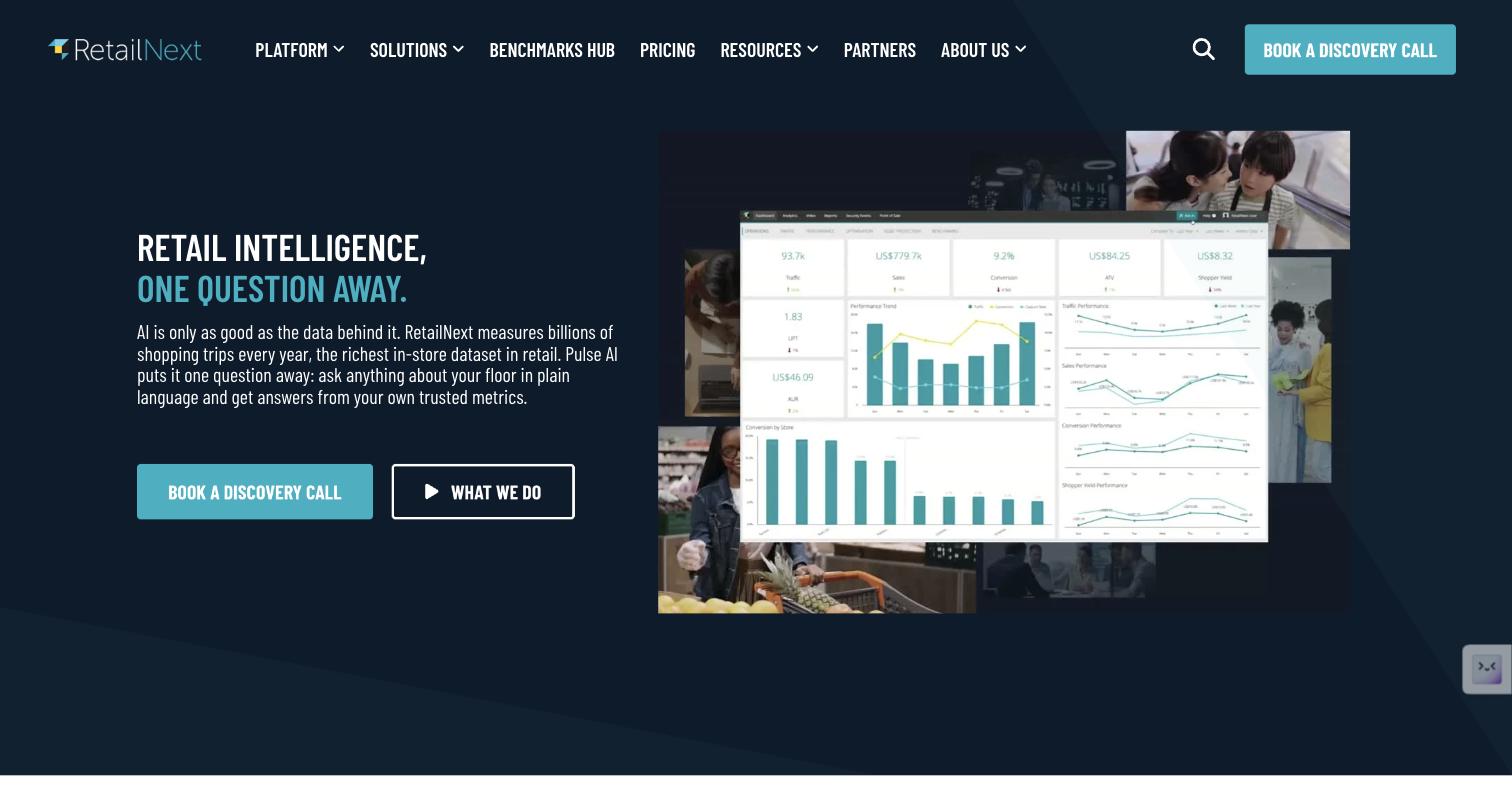
RetailNext calls itself the richest in-store dataset in retail, serving 600+ retailers globally. Its Insights module maps the full customer journey, showing which zones drive engagement, which layouts convert, and where shoppers drop off before reaching the register — and its newer Pulse AI feature lets non-technical staff query that data in plain language.
- Heatmap and journey-mapping across every zone on the floor
- Pulse AI conversational interface for instant, no-code reporting
- Combines traffic analytics with asset-protection/loss-prevention video intelligence
- Role-specific dashboards for merchandising, operations, and marketing teams
Best for: large retail chains that want heatmap data unified with sales, conversion, and loss-prevention analytics in one enterprise platform.
4. FootfallCam

FootfallCam’s in-store analytics suite generates customer-engagement heatmaps alongside six other movement metrics, from path tracking to customer-staff interaction. Its annotation workspace even lets merchandisers simulate product placements before making a physical change and compare engagement across multiple stores.
- Storewide customer-flow heatmaps and path-tracking visualizations
- Demographic segmentation by age, gender, and sentiment
- Product-engagement and dwell-time measurement by fixture
- Multi-store comparison and layout-simulation tools
Best for: retailers who want to A/B test store layouts and merchandising changes before rolling them out chain-wide.
5. Milesight
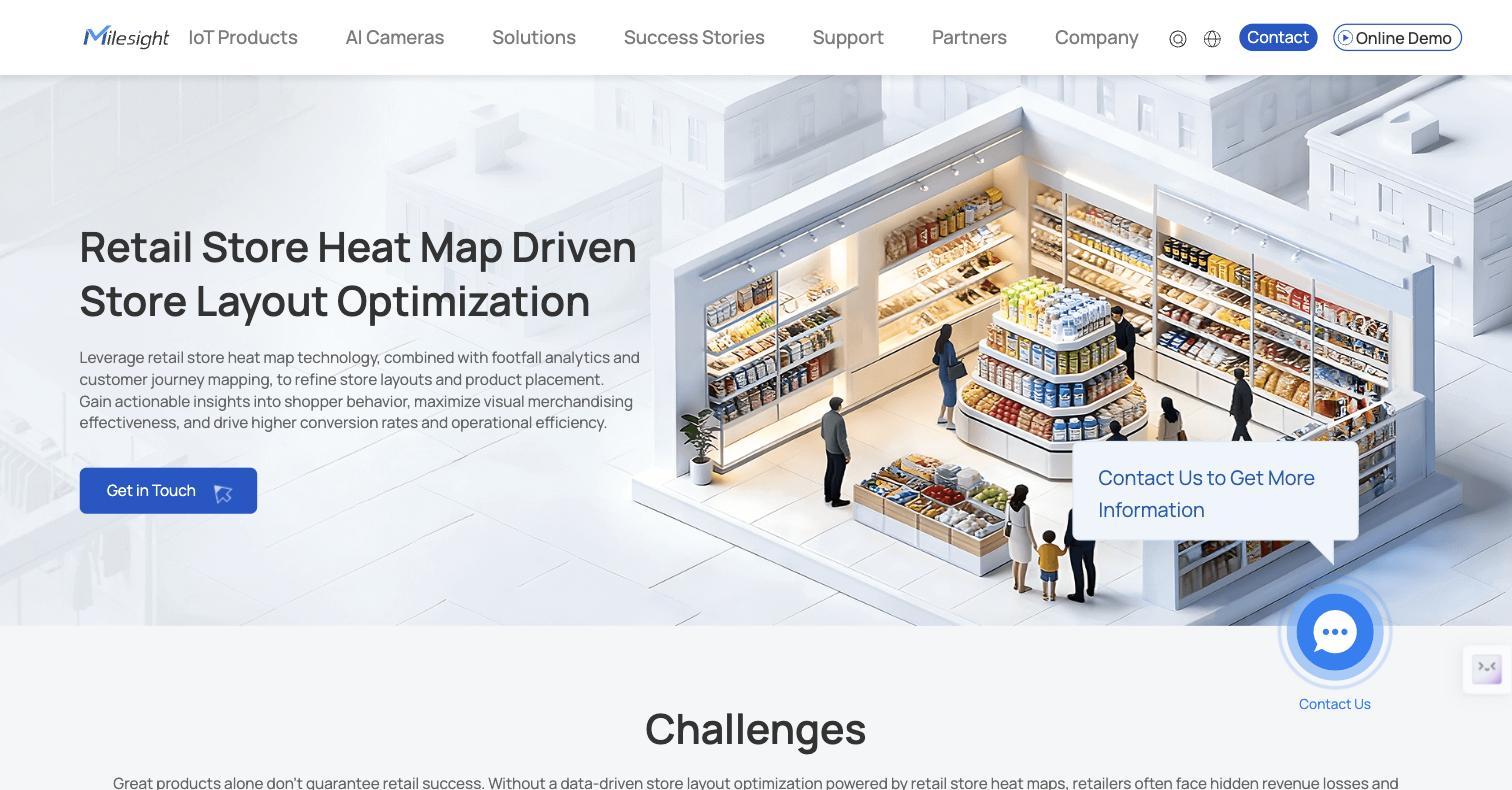
Hardware specialist Milesight pairs its own 3D-vision and Time-of-Flight sensors with a retail analytics platform built specifically around heat-map-driven store layout optimization. Its VS125 series adds view-direction detection to identify what actually catches a shopper’s attention, while the VS13x ToF series delivers 99.8% precision with fully anonymous, GDPR-compliant capture.
- Choice of 3D-vision (VS125) or Time-of-Flight (VS13x) sensors
- Color-coded floor-plan heat maps of traffic and dwell time
- Flexible installation: PoE, 4G cellular, or LoRaWAN connectivity
- Own hardware and software stack, reducing vendor hand-off issues
Best for: retailers who want to own their sensor hardware outright rather than subscribe to a fully managed analytics service.
6. Ariadne

Ariadne takes a camera-free, privacy-first approach, fusing patented phone-signal sensing with Time-of-Flight depth sensing (“Hybrid Fusion”) for sub-meter accuracy without ever capturing images of shoppers. Its heatmaps use warm colors for high-traffic zones and cool tones for quiet ones, then overlay category sales data so teams can tell attention apart from actual purchase intent.
- Camera-free Hybrid Fusion sensing (phone signal + ToF)
- No PII collected — GDPR-native and built for the EU AI Act
- Daily, hourly, and peak-vs-off-peak heatmap overlays
- Conversion insights that connect foot traffic to category sales
Best for: privacy-conscious retailers and shopping centers that want zero-camera, sub-meter accurate tracking.
Visit Ariadne →
7. Density
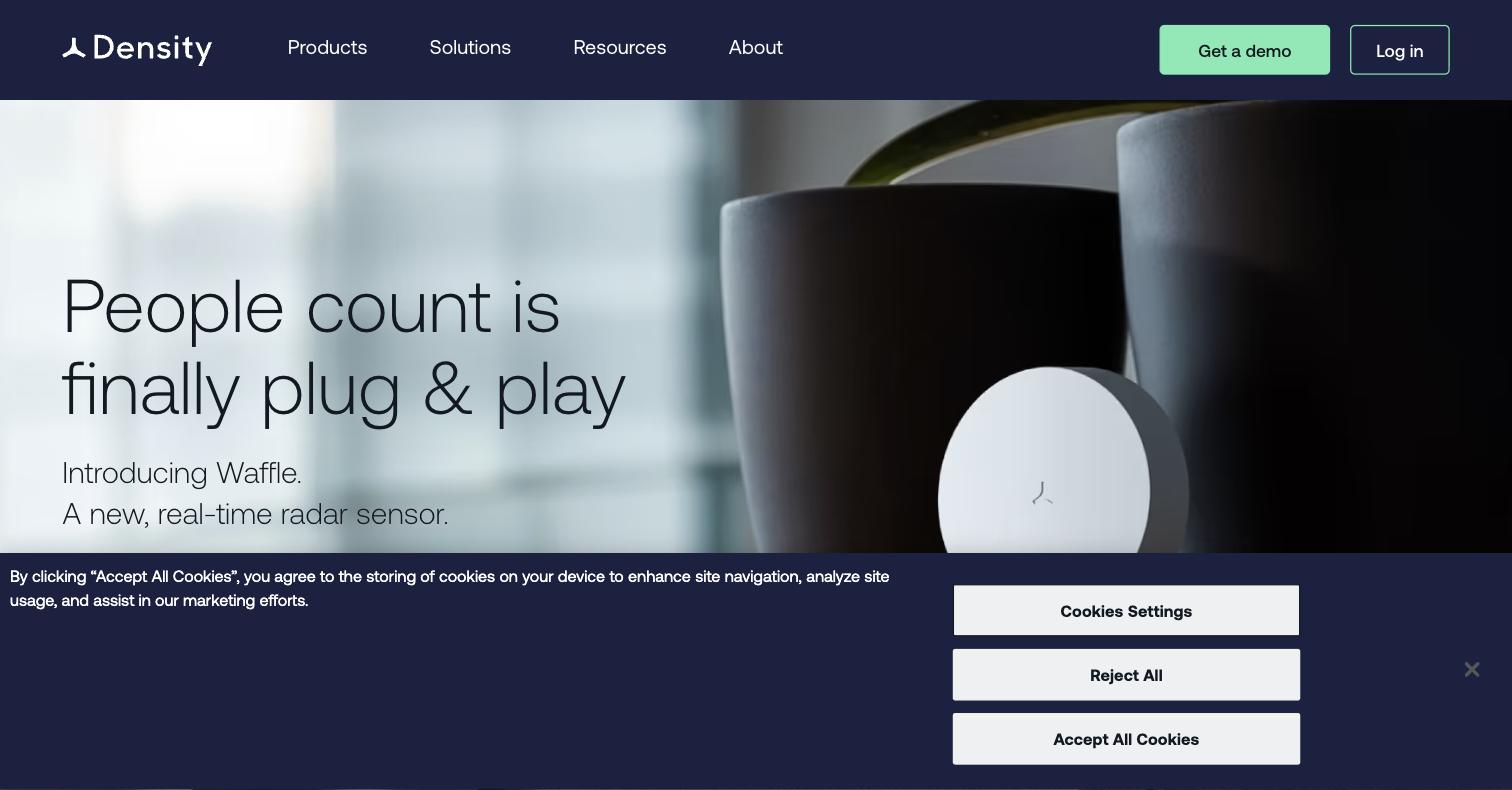
Density built its name on plug-and-play occupancy sensors for workplaces, and that same radar-based technology (its newest sensor, Waffle) applies directly to retail space-utilization and heatmap use cases through its Atlas Analytics dashboard. It is a strong option for retailers who also need to monitor back-of-house, warehouse, or mixed-use retail/office space.
- Battery-free, plug-and-play radar sensors with fast installation
- Real-time and historical occupancy data via API with sub-second latency
- Atlas Analytics for space-utilization visualization and reporting
- Enterprise-grade reliability, used by companies like ExxonMobil and Stripe
Best for: retailers with mixed-use spaces (retail plus office, showroom, or warehouse) who want one occupancy platform across all of it.
8. Sensormatic Solutions (ShopperTrak Analytics)

Now part of Johnson Controls, Sensormatic’s ShopperTrak Analytics is one of the longest-running names in retail traffic intelligence. Its overhead people-counting sensors feed a centralized dashboard that separates staff from shoppers for accurate conversion-rate reporting, and it benchmarks a store’s traffic against market and industry data.
- Decades of installed base and traffic-benchmarking data across retail categories
- Employee-exclusion for accurate conversion-rate calculations
- Real-time occupancy monitoring for staffing and compliance
- Optional integration with HappyOrNot for a combined traffic + satisfaction view
Best for: large chains that want their heatmap and traffic data benchmarked against broader market and industry trends.
9. Scanalytics

Scanalytics (now part of East West) takes a completely different approach: an ultra-thin, pressure-sensitive smart-flooring layer installed invisibly beneath standard LVT, carpet, or vinyl. With no cameras at all, it reconstructs full movement journeys — entry points, navigation patterns, dwell times, and exits — into a real-time, zone-by-zone activity heatmap.
- Camera-free, floor-embedded pressure sensors (Department of Energy-backed technology)
- 100% anonymous tracking with no video or image capture
- Command-center dashboard with real-time occupancy and traffic heatmaps
- Minimal-install ROI: sensors placed strategically at entries/exits
Best for: retailers who want camera-free heatmaps and are open to a flooring-based sensor install during a renovation or fit-out.
10. V-Count

V-Count markets itself as the world’s #1 AI people counter and retail analytics platform, and its heatmap and zone-analytics module is one of the most mature on the market. Using 3D Active Stereo Vision sensors, V-Count visualizes exactly where shoppers navigate, pause, and engage, then layers on demographic and queue data.
- Up to 99% accurate 3D stereo-vision people counting
- Heatmaps plus gender/age demographic recognition
- Staff-exclusion via Bluetooth tags so employee movement does not skew data
- Storefront and window-display passerby analytics
- GDPR-compliant, on-device processing with no facial recognition
Best for: multi-location retail chains and enterprise brands (V-Count counts Nike, Cartier, and Sephora among its clients) that want heatmaps bundled with full people-counting and queue management.
Retail Heatmap Solutions Compared
| Provider | Sensor Technology | Camera-Free | Best For |
|---|---|---|---|
| Xovis | 3D overhead sensors | No | Malls & flagship stores |
| Vemco Group | Multi-sensor (VemTrack) | No | Easy-to-read dashboards |
| RetailNext | Computer-vision (Aurora) | No | Enterprise chains + loss prevention |
| FootfallCam | 3D dual fisheye camera | No | Layout A/B testing |
| Milesight | 3D vision / Time-of-Flight | Yes (ToF model) | Owning your own hardware |
| Ariadne | Phone signal + Time-of-Flight | Yes | Privacy-first tracking |
| Density | Radar (Waffle) | Yes | Mixed-use retail/office space |
| Sensormatic (ShopperTrak) | Overhead people-counting | No | Market-benchmarked traffic data |
| Scanalytics | Floor pressure sensors | Yes | Camera-free flooring install |
| V-Count | 3D Active Stereo Vision | No | Enterprise multi-location retail |
Frequently Asked Questions
What is a retail heatmap?
A retail heatmap is a color-coded visualization of a store’s floor plan showing where customers walk, pause, and spend the most time. Warm colors (red/orange) typically mark high-traffic or high-dwell zones, while cool colors (blue/green) mark areas shoppers rarely visit.
How much do retail heatmap solutions cost?
Pricing varies widely by sensor count, store size, and whether hardware is purchased or leased as part of a subscription. Most vendors on this list quote custom pricing based on square footage and number of locations, so request a quote directly rather than relying on a published rate.
Do retail heatmaps require cameras?
No. While vendors like V-Count, Xovis, and FootfallCam use camera-based 3D or vision sensors, privacy-first alternatives like Ariadne, Density, and Scanalytics generate heatmaps using phone-signal, radar, or floor-pressure sensors with no video capture at all.
Are retail heatmap solutions GDPR compliant?
The vendors covered here all market GDPR-compliant, anonymous processing, but the level of privacy varies. Camera-free platforms (Ariadne, Density, Scanalytics) avoid capturing personally identifiable imagery entirely, which can simplify compliance in the EU, UK, and other regulated markets.
Final Thoughts
There is no single best retail heatmap solution for every store — the right choice depends on store size, budget, whether you want camera-based or camera-free sensors, and how deeply you need heatmap data tied into POS and staffing systems. Enterprise chains with existing video infrastructure tend to gravitate toward V-Count, RetailNext, or Sensormatic, while privacy-first or camera-averse retailers are better served by Ariadne, Density, or Scanalytics.
For a broader look at people-counting hardware across all these vendors and more, see our Top 10 People Counting Solution Providers guide, or browse the full PeopleCountings directory to compare providers side by side.